

Earnings Calendar
A calendar of company earnings reports: who reports when across US stocks, with consensus EPS and revenue, the surprise once they print, and the options' implied move against each stock's usual one. ERN is one company's full earnings record.
EARNINGSEARNEREPSUS listings. MAJORS is every company of $100B or more plus the 27 core names (the 27 stocks among the 45 US options names), S&P 500 adds every S&P 500 and Nasdaq-100 member, ALL US is every US listing.
Typing it
EARNINGSWhat you see
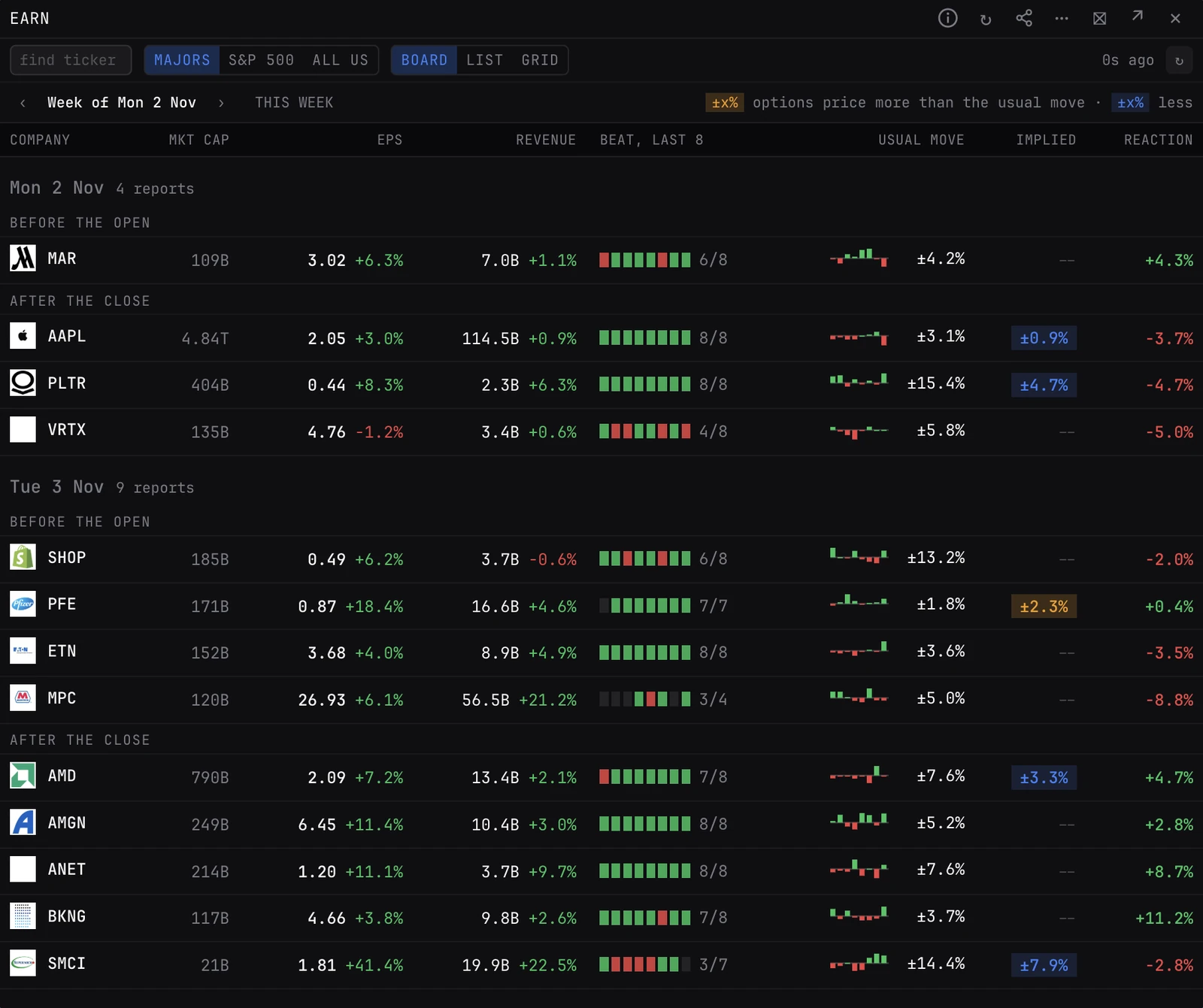
- BOARD. Where it opens: one week, day by day, split into before the open, during the session and after the close, biggest first. For each company: market cap, EPS and revenue, its beat record over the last 8 reports, its usual move, the options' implied move and the reaction. Click a company for its ERN.
- Implied vs usual. The implied move is lit amber when the options price at least 25% more than the stock usually moves on a report, and blue when they price at least 20% less.
- LIST. Reports by day, biggest first: time, ticker, market cap, EPS actual and estimate, revenue actual and estimate, and surprise. Under each day a line opens that day's reports outside the list you picked.
- Chips. tracked marks one of the 27 core names, whose options, GEX and flow the terminal carries. The bitcoin chip marks a crypto proxy (MSTR, COIN, MARA, RIOT, CLSK). LCL marks a non-US company whose EPS and revenue are in its own currency, not USD.
- Expand. Click a row in LIST for EPS and revenue actual, estimate and surprise, and the release time. Crypto proxies also show BTC's 4-hour move after their last 8 reports.
How to read it
- Amber implied moves: the options price a bigger move than the stock usually makes, so the event premium is rich. Blue: it is cheap against history.
- A long beat record with small reactions: the beat is expected and priced.
- Prints that land inside an options expiry you are positioned into.
- Surprise is actual minus estimate, over the size of the estimate. Green beat consensus, red missed.
Controls on the EARNINGS panel
- BOARD / LIST / GRID
- The week's board (the default), reports by day, or a calendar grid. The free plan opens on LIST; the board and its implied moves are paid.
- MAJORS / S&P 500 / ALL US
- Which companies. MAJORS is the default. The board reads each company's record, so on BOARD, ALL US shows the S&P 500, the Nasdaq-100 and every company of $100B or more.
- TODAY / 2 WEEKS / 30 DAYS / PAST
- On LIST and GRID: today, the next 14 days (the default), the next 30, or the last 30 with actuals.
- ‹ / › / THIS WEEK
- On BOARD: the week before, the week after, and back to this week.
- find ticker
- Type a ticker and press Enter: opens its next report, or its last if none is due, and marks it.
Good to know
- A time marked "~" is approximate, set from the before-open, midday or after-close marker (07:30, 12:00 or 16:05 ET). TBC means the report has a date only.
- Usual move is the stock's average move either way over its last 8 reports, from the close the day before to the close the day after. Implied is the front expiry's straddle (an at-the-money call plus put), for the 27 core names.
- A window with more than 2,000 reports shows the 2,000 nearest today, and the header says so.
Also on the chart
The same data can sit on the price chart. Press / on the chart and search for:
Pairs well with
ERNCALENDARFUNDAMENTALSEMSCANOPEX
Questions
How is EARNINGS different from ERN?
EARNINGS is a calendar across many companies: who reports when, and what is expected. ERN is one company's earnings record: EPS or revenue by quarter against the consensus and how the stock moved on every report. Click a company on the board to open its ERN.
Can I see a company that is not in the list?
Type its ticker in find ticker, or switch the list to S&P 500 or ALL US. In LIST, the line under each day opens that day's other reports.
What is the implied move?
The move the options price for the report, read from the front expiry's straddle (an at-the-money call plus put). Against the usual move it shows whether the event premium is rich or cheap.