

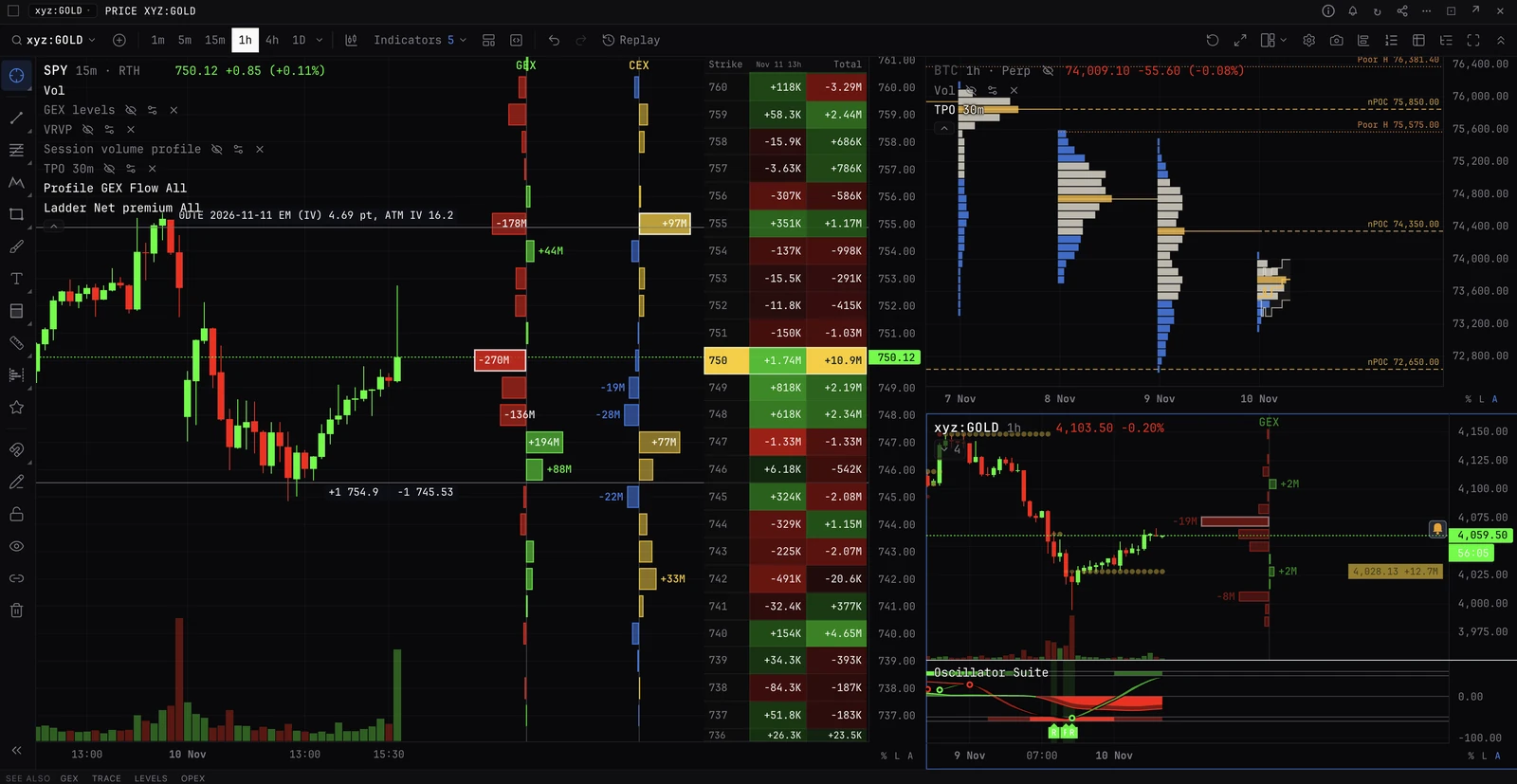
Positions and orders
One panel, named Positions and orders everywhere: BLOTTER opens it in the Pro terminal, and it sits on the trade page and on every trading desk. Tabs: Positions, Orders, Fills, Closed and Algos, every account’s or one. New to these words? See New to trading.
BLOTTERTrade page and Pro terminal

At the top
- Tabs
- Positions, Orders, Fills, Closed, Algos, each with its count: open positions, working orders, fills, closed trades and running algorithms, added over every account shown.
- Every account
- With more than one account connected: rows from every account, each under its name; an account with nothing on the tab is left out. A row’s buttons act on its own account, and choosing its market moves the panel to that account and market. On by default.
- [market] only
- Only the panel’s market.
- Checked with the venue
- On Orders: when the account last read its orders and positions from the exchange to the end. A working order older than that was confirmed by it.
- Last known state, as of
- In amber, the rows dimmed: not updating right now, so the rows show what was last read, and as of when. After a reload, the rows last seen in this tab show at once until the exchange is read again.
- The Portfolio page
- Shows the same positions grouped into structures, every account at once. Its Close only loads the ticket there; Close here sends, after you confirm.
While the account connects
On a fresh open, the positions and working orders this device last saw show at once, dimmed, under the connecting line: Last seen N min ago, not live yet. Each position with its side, size, entry and the PnL as it was then; each order with its side, size, price and kind. Nothing in them can be pressed. They give way to the live rows once the account is in, and are gone on a sign-out, a lock or the key removed.
Positions: the columns
| Column | What it shows |
|---|---|
| Position | Market; Long or Short, leverage, cross or isolated |
| Size | Size and unit; under it the value at the mark |
| Entry · Mark | Entry; under it the mark, live |
| uPnL | Live profit and currency; under it ROE (return on margin) |
| Liq. price | The exchange’s liquidation price |
| Margin | The exchange’s margin for it |
| TP / SL | Stops on it, one a line, or Set |
| Delta | In coins, four figures |
- What it shows
- Market; Long or Short, leverage, cross or isolated
- What it shows
- Size and unit; under it the value at the mark
- What it shows
- Entry; under it the mark, live
- What it shows
- Live profit and currency; under it ROE (return on margin)
- What it shows
- The exchange’s liquidation price
- What it shows
- The exchange’s margin for it
- What it shows
- Stops on it, one a line, or Set
- What it shows
- In coins, four figures
- A line at the left
- Green for a long, red for a short.
- Market name
- Shows that market on the panel’s desk. Sends nothing.
- Size
- The exchange’s own figure, size held from before the key was added included. The value under it is at the mark in the quote currency; an inverse contract’s (sized in dollars, settled in the coin) is its contracts times the contract size.
- Mark
- The exchange’s mark price; where its feed has none, the mid or the last trade, said on hover.
- uPnL and ROE
- Profit at the live mark. ROE is on the margin it was opened on: the entry notional over the leverage, as the exchange and the PnL card count it. Where only the entry is known, it says since entry.
- Delta
- The exchange’s delta where it states one; else, for a perp or future, the size in coins (an inverse contract’s dollars over the mark). An option with no stated delta, or a prediction market, shows -.
- Any figure
- One the exchange does not state shows as -, never as zero.
- Prediction markets
- The side held (Yes, No, Up, Down) and when it resolves, in place of long or short; the value at the mid, and what it pays if right on hover.
- At the venue
- Shown in place of Close on a market this account lists but BackQuant does not trade: close it on the exchange.
Close ▾
- Close all at market, Close 50% at market, Close 25% at market
- Reduce-only where the exchange allows it, after you confirm (Close at market or Keep). A share is rounded down to the market’s size step; under one step it says so. One close per position at a time: a second press while the first is on its way sends nothing, and says so.
- Close with a limit...
- Loads a reduce-only limit at the touch into the ticket, to check and send there.
- Close by chase...
- Loads the close into the ticket as a chase: a limit that follows the touch until it fills, reduce-only where the exchange allows it. Check and start it there. Offered wherever the market takes the algorithm: every exchange, not prediction markets.
- Close by TWAP...
- Loads the close into the ticket as a TWAP: slices over a time you set, reduce-only where the exchange allows it. Offered wherever the market takes the algorithm.
- Stop at breakeven
- Perps and futures: the stop loss at the entry price (on the tick, toward the profit), once the mark is past the entry by two ticks or 0.05%, whichever is more. Where the exchange holds a stop on the whole position, that stop is moved there; elsewhere a reduce-only stop order for the whole size, and the old stop orders are cancelled only once the new one is working. A stop already at or past breakeven stays: never loosened. The confirmation says, line by line, what it does (Set the stop or Keep).
- Reverse at market
- Perps and futures, where the exchange takes reduce-only orders. Asks first (Reverse at market or Keep), then closes the whole position at market, reduce-only, and opens the same size the other way at market only once that close has filled whole and the position shows flat. A close that fills in part, is held, or meets a price that is not live opens nothing, and says why. Not done while a hedger or an algorithm trades that market.
- Stop at breakeven, every position
- With more than one perp or future open: every one in profit, in one confirmation. Those that cannot are listed with why, and left as they are.
- Not ready yet
- While the account connects or reconnects, or its list of markets is still loading, a close at market is held: see Held closes.
The ⋯ menu
- PnL card
- A card of the position to share. See PnL card.
- Take profit / stop...
- Where the exchange holds no stop orders of its own but takes a resting reduce-only order (options on Deribit and Bybit; not OKX options): a reduce-only take profit at the exchange, and a stop BackQuant watches (Watching Mark, Last, Index or Mid, then no worse than a price you set). Both together are one-cancels-the-other. The menu says this tab, but the stop is watched while any BackQuant tab in this browser is open; once the last one closes, the stop is gone and the take profit stays as a plain order.
- Roll to a later expiry...
- Options and futures: closes the position and opens the same at a later expiry. The window: The option chain. What it sends: How exits, closes and rolls work.
- Load a delta hedge into the ticket
- The perpetual order on the same account that offsets the position’s delta, at the perpetual’s touch. Nothing is sent. Not offered on a prediction market.
TP / SL at the exchange
The TP / SL cell lists the stops working on the position, stop above take profit: those the exchange holds on the whole position, and this account’s working reduce-only stop orders on the closing side (a part-size one says of how much). Where the exchange sets stops on a whole position, Set (or the stops) opens the window that sets them. Deribit, Derive, Lighter and RISEx hold none on the whole position: use a reduce-only Stop / take profit from the ticket, or drag one from the chart.
| Exchange | On | Watches | Trailing | One of each |
|---|---|---|---|---|
| Hyperliquid | Perps | Mark | No | No |
| Bybit | Perps, futures | Mark, Last, Index | Yes | Yes |
| Binance futures | Perps, dated futures | Mark, Last | No | No |
| OKX | Perps, futures | Last, Mark, Index | No | Yes |
| Deribit, Derive, Lighter, RISEx | None | - | - | - |
- On
- Perps
- Watches
- Mark
- Trailing
- No
- One of each
- No
- On
- Perps, futures
- Watches
- Mark, Last, Index
- Trailing
- Yes
- One of each
- Yes
- On
- Perps, dated futures
- Watches
- Mark, Last
- Trailing
- No
- One of each
- No
- On
- Perps, futures
- Watches
- Last, Mark, Index
- Trailing
- No
- One of each
- Yes
- On
- None
- Watches
- -
- Trailing
- -
- One of each
- -
- Take-profit, Stop-loss
- Type a price, or -2%, -5%, -10% or +2%, +5%, +10% from the mark, toward each one’s side. Each shows its distance from the mark, the profit or loss there, and the one standing now. Clear removes one.
- Watches
- Mark, Last or Index, where the exchange offers more than one.
- Trailing stop
- Trail in bps or price, starting now or at a price you set (Starts at).
- Set at the venue
- Sends it. Nothing to change while the form matches what stands. Where the exchange keeps one of each per position, setting one replaces the one standing; where it moves one by placing the new first, both stand for a moment.
Isolated margin
On an isolated position the exchange lets you change, the Margin figure opens the margin window: the margin set aside, the liquidation price and the leverage.
| Exchange | Add | Take out | Automatic top-up |
|---|---|---|---|
| Hyperliquid | Yes | Yes, where the market allows | No |
| Bybit | Yes | Yes | Yes |
| Binance | Yes | Yes | No |
| OKX | Yes | Yes | No |
| Lighter | Yes | Yes | No |
| RISEx | Yes | Yes | No |
- Add
- Yes
- Take out
- Yes, where the market allows
- Automatic top-up
- No
- Add
- Yes
- Take out
- Yes
- Automatic top-up
- Yes
- Add
- Yes
- Take out
- Yes
- Automatic top-up
- No
- Add
- Yes
- Take out
- Yes
- Automatic top-up
- No
- Add
- Yes
- Take out
- Yes
- Automatic top-up
- No
- Add
- Yes
- Take out
- Yes
- Automatic top-up
- No
- Add, Take out
- An amount in the position’s collateral, a whole number of the exchange’s step (nothing is rounded), never more out than is set aside. More set aside moves the liquidation price away from the market; less moves it toward it. Add at the venue or Take out at the venue sends it.
- Automatic top-up
- Where the exchange has one: it adds margin from the account by itself before liquidating the position. Turn on or Turn off.
- Not known yet
- If an answer does not come, it says so and sends nothing more until the figure changes or the window is opened again.
Held closes
A close at market pressed while the account is not ready (connecting, reconnecting, its list of markets still loading) is never refused and never silent. It asks first (Close when ready or Keep), then is held for up to a minute and sent once, the moment the account is ready, built from the position and the price as they are then: cut to the position as it is, or nothing if it has closed. A toast says when it went, or why it did not. A close that sends nothing removes nothing: stops, take profits and hedgers stay as they were.
Packages
- A package
- A structure placed as one (from the basket or structures ticket) shows as one row above its legs: its name, its hedge (No hedge; Neutral, ±band with the last rebalance; or the hedger’s state), how many legs, the legs’ profit and delta together.
- Hedge
- Opens the package: its hedge and its rebalances.
- ⋯ Close the package at market...
- One confirmation listing every order. A package’s own hedger is stopped first, legs still working are withdrawn, then the legs close (options of two to four legs together by chase, from their own side of the book), and the hedge only once every leg has closed.
- ⋯ Ungroup (positions stay)
- The legs become plain rows. Nothing is sent.
The positions footer
Long, Short and Net in dollars at the mark, where every position is a perp, future or spot quoted in dollars; then uPnL, per currency where they differ. A prediction market’s profit counts; its holding is not long or short of the coin it watches.
Orders
- Working only
- On by default. Off shows filled, cancelled and refused orders too.
- Columns
- Updated, Instrument, Side, Qty, Filled, Left, Price, Type, State, and From where an order came from somewhere.
- Price
- A limit’s price, a trigger’s TP or SL price, or Market.
- Type
- Limit, Market, Mkt capped (Deribit’s Market, capped), or TP or Stop (lim or mkt) with the price it watches and whether it has fired or is waiting. Then the time in force, a GTC order’s life in days where the exchange expires it, PO (post-only), RO (reduce-only), and +TP/SL, +TP or +SL when exits are attached.
- From
- Attached: closes what another order opened. Earlier: placed from this terminal in an earlier session. External: placed on the exchange’s site or another device. An algorithm’s child names it.
- Amend
- New price, New trigger or New total size, where the exchange can change them.
- Cancel
- Sends at once, a stop or take profit too; a second press while it is on its way sends nothing. While the account reconnects, it is held and goes when the account is ready. (The Portfolio page’s Open orders asks first before cancelling a stop or take profit.)
- Refused or unknown
- A refused order says the exchange’s reason, with a hint where there is one. One whose fate is not known yet says so in amber.
Fills, Closed, Algos
- Fills
- Since the key was added here: time, instrument, side, qty, price, fee, maker or taker, and the exchange’s order id (click to copy). Older trades are under Closed, and the Portfolio page’s equity curve, on Fills, reads further back from the exchange (Load older).
- Closed
- Trades from flat to flat over 24H, 7D (default), 30D or 90D, from the exchange’s fill history: closed time, instrument, side, size, entry, exit, PnL before fees (the fees on hover), return (on margin at the leverage held, else the price move), time held, and Share. Where the window holds more fills than are read at once, it asks for a shorter one. A position closed while the panel is open offers its card in a toast.
- Algos
- Each running algorithm: type, instrument, side, requested, filled, left, average, status, what it is waiting on, time elapsed, and its child orders, oldest first. Pause, Resume, Edit (Limit, Target, Stop at) and Cancel. An OCO entry (a one-cancels-the-other pair) is one row (First to fill cancels the other) with Cancel both.
PnL card
ROE, PnL % or PnL $; entry and mark Exact, Rounded or Off; the exchange by Name or Logo, or Off; time held, your username, a price line, a caption and a background, an image or a video. Copy text, Save image, Copy image, Save video, Post to chat (the terminal’s own chat, where it is on) or Post on X.
Questions
Why does a close say reduce-only?
A reduce-only order can only make the position smaller: if something else closes it first, the close cannot open the other way. Every close here is reduce-only where the exchange allows it. A prediction market takes none: its close is the size held.
Reverse did not open the other side. Why?
The other side opens only once the close has filled for the whole size and the position shows flat. A partial fill, a held close, a price that was not live, or a hedger or algorithm on the market opens nothing, and a toast says which.
Stop at breakeven did nothing.
The mark must be past the entry by two ticks or 0.05%, whichever is more, and the stop not already at or past the entry. Options and prediction markets are not offered it. The toast says which held it back.
Why is my size larger than what I traded here?
Size is the exchange’s own figure, including size from before the key was added. Every close, stop and figure uses it, so nothing held is left out.
Why does ROE differ from the exchange’s?
ROE here is on the margin the position was opened on (entry notional over leverage). An isolated position’s margin now has any loss taken out of it, so a figure on it would read about twice as deep.
Where are trades older than my key?
Under Closed, read from the exchange’s own fill history for the window chosen. Fills shows only what came since the key was added here.
More
- Close a position or get flat. Step by step.
- Stops, exits and hedges. Every exit, and which each exchange holds.
- How exits, closes and rolls work. What each close sends, in order.