


Risk Parity
Portfolio weights that make every asset carry the same share of total risk, set against an equal-weight portfolio, with the weights scaled to a target volatility and how they moved week by week.
RISKPARRISKPARITYRPDaily closes for BTC, ETH, SOL, BNB and XRP; SPY, QQQ, IWM and the sector ETFs; Treasuries (TLT); gold, silver, copper, Brent and natural gas; the dollar index and major FX pairs, over the last year.
Typing it
RISKPARWhat you see
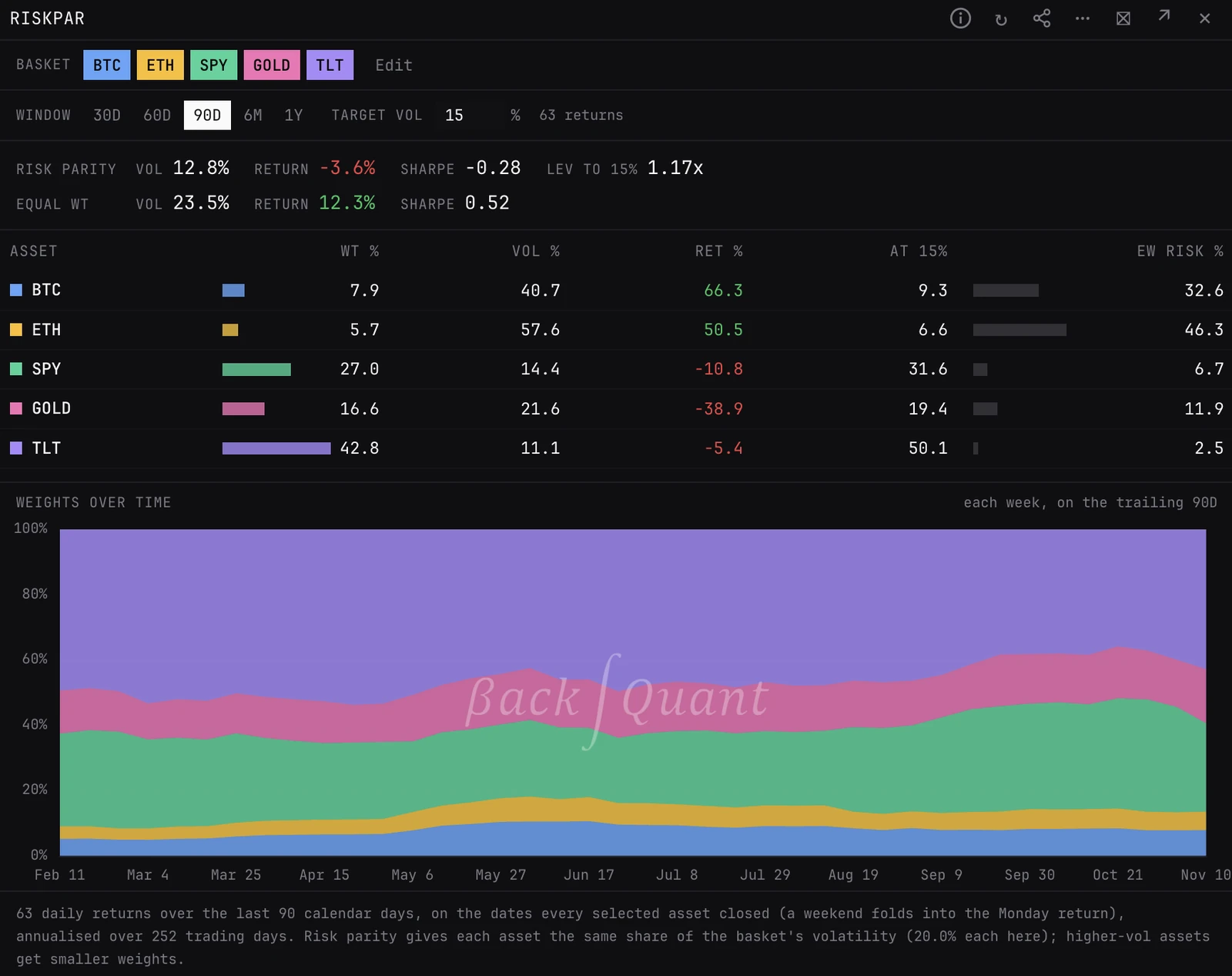
- Readouts. Risk parity: Vol, Return, Sharpe and the leverage to the target vol. Equal wt: Vol, Return and Sharpe of the same assets held equally.
- Table. One row per asset: Wt % (drawn as a bar), Vol %, Ret %, the weight at the target vol, and EW risk %, its share of the risk in an equal-weight basket. Sort by any column.
- Weights over time. The risk parity weights recomputed each week on the trailing window, stacked to 100%.
The maths
- Risk contribution. An asset's weight times its covariance with the portfolio, over the portfolio vol. The contributions add up to the portfolio vol.
- Solve. Each weight is scaled by the square root of the target share over its own, then all are renormalised, until every contribution is equal.
- Target vol. Leverage is the target over the risk parity portfolio's vol; the At target column is each weight times it.
- Data. Simple daily returns on the days every asset closed, annualised over 365 days when all trade every day, else 252.
What to look for
- Small weights on the volatile assets. Equal risk is not equal weight.
- EW risk %: in an equal-weight basket the volatile assets usually carry most of the risk. That gap is what risk parity corrects.
- Weights swinging from week to week: the covariances are unstable, and a longer window will trade less.
Controls
- Basket / + Add
- Opens on BTC, ETH, SPY, GOLD and TLT. Click a chip to remove it. + Add opens the asset picker, which stays open to add several. At least 2 are needed.
- Window
- 30D, 60D, 90D (the default), 6M or 1Y of calendar days.
- Target vol
- The annual vol the weights are scaled to, in %. 15 to start; clear it to drop the scaling.
Good to know
- Sharpe here is return over vol, with no cash rate taken off. Return is the annualised mean daily return over the window.
- Risk parity uses the covariances only: no view on expected returns goes into the weights.
- Built from the last year of daily closes, so 1Y is the longest window. It needs 20 common returns.
Pairs well with
Questions
Why is the leverage above 1?
The weights are scaled to hit the Target vol. A low-vol mix, heavy in bonds and gold, needs leverage to reach it.
Why not just hold equal weights?
Equal weights let the most volatile asset dominate the risk. The EW risk % column shows how much; risk parity gives each asset the same share.
Does it use expected returns?
No. The weights come from vol and correlation alone. Return and Sharpe are shown for comparison, from the window's history.