

Kelly Criterion
Kelly sizing: how much of your bankroll to put on a trade, worked out two ways, from your trades' win rate and payoff or from an asset's own daily returns. Each shows how far the data can be trusted.
KELLYBets works on any numbers you type. Asset uses the cross-asset daily closes (crypto majors, US index and sector ETFs, Treasuries, commodities and FX), up to five years.
Typing it
KELLYWhat you see
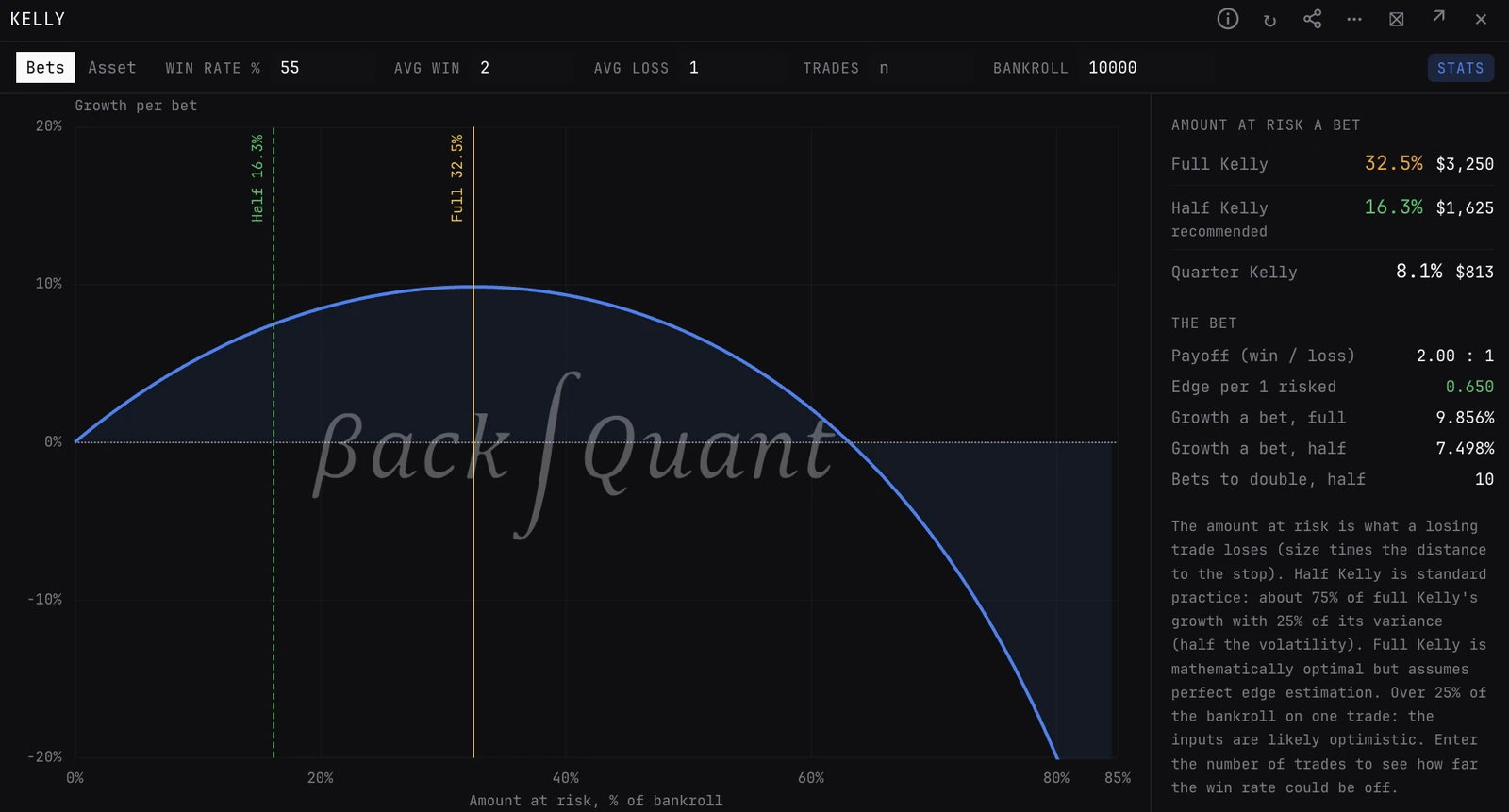
- Bets. Where it opens. The curve is growth per bet against the amount at risk, as a % of bankroll, with full Kelly at the peak and half Kelly marked.
- Bets STATS. Full, half (marked recommended) and quarter Kelly as a % and in money; the payoff, the edge per 1 risked, growth a bet at full and half Kelly, and the bets it takes to double at half Kelly.
- Cautious. With a trade count: the Kelly at the low end of the win rate's 95% range, marked dotted on the curve, with that range in STATS.
- Asset. Growth a year against leverage (position over account), the rest of the account at the cash rate. Kelly and half Kelly are marked; the shaded band is the 95% range of Kelly (mu / sigma²).
- Asset STATS. Kelly (realised), half Kelly, Kelly (mu / sigma²) with its 95% range, half Kelly on your bankroll, and the asset's mean return, vol, Sharpe and growth over the dates used.
The maths
- Bets. f* = p - (1 - p) / b, where p is the win rate and b the average win over the average loss. Growth per bet, p ln(1 + f b) + (1 - p) ln(1 - f), peaks at f* and turns negative at roughly twice it.
- Cautious. The same formula with p at the low end of its 95% Wilson interval for your trade count. 30 trades at 55% have a range of about 38% to 71%.
- Kelly (mu / sigma²). The continuous Kelly leverage: the asset's yearly mean return less the cash rate, divided by its variance. Its 95% range comes from the error of the mean alone, about the vol over the square root of the years.
- Kelly (realised). The leverage that would have grown the account fastest over the actual daily returns: no normal assumption, searched up to 20x and never past the leverage the worst day would have wiped out.
What to look for
- How fast growth falls past the peak. Betting too much costs far more than betting too little, which is the case for sizing under full Kelly.
- How wide the range is. A year of returns rarely pins Kelly down; Cautious shows what a short trade record can prove.
- With no edge the panel says so: Kelly says do not bet.
Controls
- Bets / Asset
- The mode. Bets is the default.
- Win rate % / Avg win / Avg loss
- Bets: 55, 2 and 1 to start. The win and the loss in the same unit; the loss is the amount at risk (size times the distance to the stop).
- Trades
- Bets, optional: how many trades the win rate comes from, 5 or more. It gives the Cautious Kelly.
- Asset
- Any asset in the cross-asset daily closes; pick it with the asset picker. BTC to start.
- History
- Asset: 1Y, 2Y, 3Y (the default) or 5Y of daily returns.
- Cash %
- Asset: 4 a year to start. What the rest of the account earns and what borrowing for leverage costs.
- Bankroll
- Turns each size into money. 10,000 to start.
- STATS
- Shows or hides the sizing column.
Good to know
- Half Kelly is standard practice: about 75% of full Kelly's growth with a quarter of its variance (half the volatility). Full Kelly assumes you know your edge exactly.
- Bets warns when full Kelly puts over 25% of the bankroll on one trade: the inputs are likely optimistic.
- Asset uses simple daily returns, annualised over 365 days for crypto and 252 for an exchange-traded asset, and needs 30 of them. A negative Kelly means short.
Pairs well with
Questions
Should I bet full Kelly?
Rarely. The growth curve is flat near the top, so half Kelly gives up little growth for much smaller drawdowns, and full Kelly assumes you know your edge exactly.
Why does Asset give leverage, not a percentage?
For an asset you hold, Kelly is the position as a multiple of the account: 0.5x is half the account in the asset and half in cash, 2x is borrowed. A negative figure means short.
Do SIZING and POSITION open KELLY?
No. They open POSSIZE, which sizes from your stop distance and a fixed risk budget; KELLY sizes from your odds and payoff. Neither shows your positions: those are in Positions and orders (BLOTTER) on the trade page.