

Every order type
Every order BackQuant sends, on options, futures, perpetuals, spot and prediction markets, on every exchange: what each one does, when to use it, and whether the exchange or BackQuant holds it. New to these words? See New to trading.
TICKETBUYSELLThe ticket, the DOM, the chart, Positions and orders
Who holds an order
Every order is held by one of two things. The exchange: the order sits in its book, or in its list of stops waiting for a price, and works whether BackQuant is open or not. Or BackQuant’s trading engine, which runs in your browser: it watches prices and time, and sends ordinary orders to the exchange when they are due. The exchange only ever sees those ordinary orders.
What the engine holds needs a BackQuant tab open in this browser. Every tab shares one engine, so closing one tab while another stays open changes nothing. Once the last tab closes the engine stops: orders already at the exchange stay there, and nothing the engine was watching is watched. The two tables further down say which is which, on each exchange.
Where the ticket says watched in this tab, it means watched by that shared engine: while any BackQuant tab in this browser is open. The touch, used throughout, is the best bid and the best ask now.
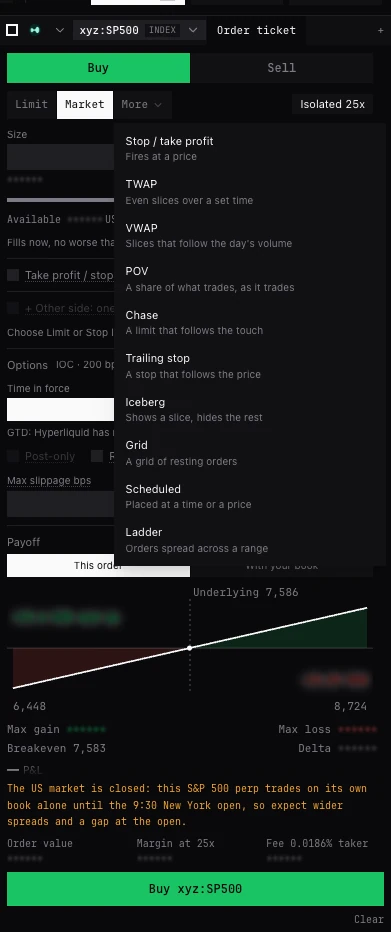
The ticket offers only what the account and market take, so a type missing from it is one that exchange or market does not have.
Limit
- What it does
- Buys at your price or lower, sells at your price or higher. What can fill at once fills; the rest rests on the book until it fills, you cancel it, or its time in force ends.
- Use it
- Whenever the price matters more than filling now: an entry at a level, an exit at a target, anything in a thin book. A limit at or through the touch fills at once like a market order, but never past its price.
- In the ticket
- Limit, then Price. Bid, Mid and Ask fill the price in. An option’s price can be typed in the exchange’s units, in USD or as IV.
- Price guard
- A limit more than 2% through the touch asks you to confirm. More than 10% through, it is not sent.
- Held by
- The exchange, everywhere.
Market
Fills now against the book, best prices first. BackQuant never sends one without a live price on screen, and caps how far it may fill wherever the exchange takes a cap.
- Max slippage bps
- In the Options fold (the ticket’s order settings): the cap is the live touch plus this much. Default 200 (2%), a whole number from 1 to 500. A buy with the ask at 65,000 shows under the size: Fills now, no worse than 66,300 (200 bps).
- Capped
- Hyperliquid, Bybit, Derive, Lighter, OKX and RISEx. The order goes as an immediate order at that worst price: what the book cannot fill by then is cancelled, and nothing rests.
- No cap
- Deribit and Binance take no price on a market order. The ticket says so: Fills now at whatever the book offers: Deribit takes no price cap on a market order. Use a limit to cap it.
- Time in force
- IOC, the default, or FOK where the exchange takes it: the whole size now, or nothing.
- Use it
- When being filled now matters more than the price: getting out, or catching a move. In a thin book or a fast market, a limit through the touch does the same with a price you chose.
- Held by
- The exchange, for the moment it takes to fill.
Market, capped
On Deribit only, beside Limit and Market: Deribit’s own market order, capped at a protective price Deribit chooses. It fills now up to that price; what does not fill is cancelled and nothing rests. Use it on Deribit for a market order with a cap you do not set yourself. Like a limit, more than 2% through the touch asks first.
Post-only
A limit that only ever rests. If it would fill at once, against an order already on the book, the exchange does not let it: so it never pays the taker fee. In the Options fold, for a resting limit (GTC or GTD), on every exchange. Use it to enter as a maker, or to quote. On the algorithms it is offered for Chase, Iceberg, Grid, Scheduled and Ladder; TWAP, VWAP and POV rest post-only by their Aggression instead.
IOC and FOK
- IOC
- Immediate or cancel: fills what it can at once, at your price or better, and the rest is cancelled. Nothing is left on the book. Use it to take what is there. Every exchange.
- FOK
- Fill or kill: the whole size at once, or nothing. Use it where a part fill is worse than none, such as one leg of a hedge. Deribit, Bybit, Derive, RISEx, Binance and OKX; Hyperliquid and Lighter have no FOK.
GTC and GTD
- GTC
- Good till cancelled: rests until it fills or you cancel it. The default for a limit. Two exchanges end it anyway, and the fold and its header say so: Lighter after 28 days (GTC 28d); Derive after 119 days, or when the account’s session key expires if that is sooner.
- GTD
- Good till date: rests until it fills or the time in Expires. Derive, 10 seconds to 120 days ahead and not past the session key; Lighter, 5 minutes to 30 days ahead; Binance futures, more than 10 minutes ahead. A time outside those is refused in the ticket, never moved. Elsewhere GTD is not offered, and the fold says why.
- On a stop
- A stop waits for its price, so it is GTC, or GTD on Derive. Never IOC or FOK.
Reduce-only
Can only shrink or close a position, never open one or turn it the other way. Use it on every exit, so an order that fills after the position has closed cannot open a new one.
- Where
- Perpetuals and futures on every exchange, and options on Deribit, Bybit and Derive. Not on spot, where you hold a balance, not a position; not on OKX options; not on prediction markets.
- Derive
- Only on an order that fills at once: IOC or FOK. A resting reduce-only limit is refused before it is sent, and a reduce-only stop is watched by BackQuant (see Stop market and stop limit).
- Turned on for you
- Choosing Stop / take profit turns it on where the exchange takes it. Every close from Positions and orders, and Close by chase and Close by TWAP, are reduce-only where the exchange takes it.
Self-trade prevention and Show at the venue
- Self-trade prevention
- What happens if this order would trade with one of your own resting orders: Venue default, Cancel my resting order, Cancel this order or Cancel both. Chosen per order on Binance, OKX and RISEx. Elsewhere the exchange’s own rule or account setting applies (Derive refuses such an order).
- Show at the venue
- The exchange’s own iceberg on a resting limit: only this much of the order shows at a time, more as it fills. Binance spot only. Anywhere else, the Iceberg algorithm does the same from BackQuant.
Stop market and stop limit
Under More: Stop / take profit. An order that waits off the book until a price is reached, then sends a market order or a limit. Choosing it turns Reduce-only on where the exchange takes it.
- Purpose
- Stop loss or Take profit. Default Stop loss.
- When it fires: Market
- A stop market. When the trigger is reached it fills at once at what the book offers: sure to fill, not sure of the price. In a gap it can fill well past the trigger. The default where the exchange has it.
- When it fires: Limit
- A stop limit. When the trigger is reached, a limit at the price you set: sure of the price, not sure to fill. A sell’s limit must be at or below its trigger, a buy’s at or above, or it would not fill. If the market gaps past the limit, it rests unfilled.
- Trigger
- The price that sets it off. A stop that would fire at once asks you to confirm.
- On price
- Mark: the exchange’s fair price, the one it liquidates on, slow to jump on a single trade. Last: the last trade, so a brief wick can set it off. Index: the spot price across exchanges. Only those the exchange triggers on are shown. Default Mark.
- Held by
- The exchange, on every exchange that takes stops on that market (see the table below). Derive fires a stop as a limit only.
- Derive and reduce-only
- Derive holds no reduce-only stop: a reduce-only stop there is watched by BackQuant and fires only while a BackQuant tab is open. Untick Reduce-only to have Derive hold it; the ticket then warns that if the position closes elsewhere first, that stop opens a new one.
- No exchange stop
- On options on Deribit, Bybit and OKX; on spot on Hyperliquid, Derive, Lighter and OKX; on prediction markets. There, use the take profit and stop watched in the tab with the entry, or for an option position on Deribit or Bybit, Take profit / stop... in its menu.
Take profit and stop loss with the entry
The Take profit / stop loss switch under a Limit or Market order, on anything but an option, and not on a reduce-only order. Each exit closes what the entry opens and is cancelled with it. Leave TP fills as or SL fills as empty for a market order when it fires, or enter a price for a limit there (within 10% of its trigger). Held by the exchange on Bybit, Deribit, Lighter and OKX; placed by the exchange once the whole entry fills on Hyperliquid; placed by BackQuant as the entry fills on Binance futures and RISEx. Full detail: Stops, exits and hedges.
Brackets
An entry with its take profit and stop worked as one. At the exchange, as above, where the exchange takes exits with an entry. Elsewhere (Derive, options, and spot on Hyperliquid, Lighter, OKX and Binance) the ticket offers Take profit / stop loss, watched in this tab: the take profit rests at the exchange, and BackQuant watches the stop. Full detail: Stops, exits and hedges.
Trailing stop
Under More: Trailing stop. A stop that follows the price as it moves your way and fires when it turns back by the distance you set (50 bps by default). Held by BackQuant on every exchange, not at the exchange. Bybit also holds a trailing stop of its own on a whole perpetual or future position, set from the position’s TP / SL in Positions and orders, which works with BackQuant closed. Every setting: Algorithms.
One cancels the other
+ Other side: one cancels the other (OCO), under a GTC Limit, or a Stop / take profit that fires as a limit, that is neither reduce-only nor post-only. Two entries; the first to fill cancels the other. Use it to trade a breakout either way, or to take a dip or a breakout, whichever comes first. Held by BackQuant on every exchange: at most one side rests at the exchange, the other is watched. Each side can carry its own exits, except on Derive and Binance spot. Full detail: Stops, exits and hedges.
Stop at breakeven
A perpetual or future position’s Close menu, or the Stop loss to breakeven hotkey: the stop loss at the entry price, once the price is past the entry by two ticks or 0.05%, whichever is more. It never loosens a stop. Hyperliquid, Bybit, OKX and Binance futures move their stop on the whole position; elsewhere a reduce-only stop goes to the exchange (on Derive, watched by BackQuant). Full detail: Stops, exits and hedges.
Close by chase or TWAP, and Reverse
From a position’s Close menu. Close by chase... and Close by TWAP... load a reduce-only close of the whole position into the ticket as that algorithm, to check and start there. Reverse at market (perpetuals and futures; also an armed DOM ladder or trade pad, or Shift+R) closes at market, reduce-only, and opens the same size the other way only once that close has filled whole and the position shows flat. BackQuant works the steps; every order it sends is an exchange order. Full detail: Stops, exits and hedges.
Option packages, combos and RFQ
- Package on the order book
- Two to four option legs from Structures or the multi-leg ticket go as one linked package, worked by BackQuant: the first buy leads, and no sell works past what every buy has filled. If a leg ends, the others stop at what it filled. Other packages go leg by leg, buys first.
- Combo
- Deribit. Where Deribit lists the same legs as a combo, one good-till-cancelled order at your Combo limit price, filled as a whole: no legging risk. Held by Deribit.
- RFQ
- Deribit, Bybit and Derive. Market makers quote the package; take a quote and it trades as one. Deribit quotes price levels you take by price and amount, Fill or kill or Rest; Bybit and Derive send named quotes taken exactly at their price. Taking asks first and is never retried.
- Use it
- The order book for small spreads in liquid strikes, a combo where one is listed, an RFQ for size or for strikes with wide books.
Roll
Roll to a later expiry... in an option’s or future’s position menu. It closes first and opens only what has closed: each leg rests at the touch within its No worse than price, and crosses once after Cross after s (default 20). If the open side cannot fill, the roll stops, so you are never left closed with nothing opened. Worked by BackQuant: keep a tab open until it is done. The window: The option chain. What it sends, in order: How exits, closes and rolls work.
Prediction market orders
Hyperliquid and Lighter. Limit or Market only: no stops, algorithms, leverage, reduce-only, take profit or second side. Each side is priced 0 to 1 and pays 1 a unit if it resolves your way. On Hyperliquid you buy Yes or No, each its own market, and sell only what you hold. On Lighter a Down first closes any Up you hold, and the other way round; only the rest opens. A market order is capped at the touch plus Max slippage, as on any Hyperliquid or Lighter market. Held by the exchange. See Prediction markets.
By exchange: plain orders
Every order in this table is held by the exchange. Yes on reduce-only means perpetuals and futures, plus options where the exchange has them; spot never takes it. Binance here is the Binance futures account (perps and dated futures); Binance spot connects with its own key.
| Order | Hyperliquid | Deribit | Bybit | Derive | Lighter | RISEx | Binance | OKX |
|---|---|---|---|---|---|---|---|---|
| Limit | Yes | Yes | Yes | Yes | Yes | Yes | Yes | Yes |
| Market | Capped | No cap | Capped | Capped | Capped | Capped | No cap | Capped |
| Market, capped | No | Yes | No | No | No | No | No | No |
| Post-only | Yes | Yes | Yes | Yes | Yes | Yes | Yes | Yes |
| IOC | Yes | Yes | Yes | Yes | Yes | Yes | Yes | Yes |
| FOK | No | Yes | Yes | Yes | No | Yes | Yes | Yes |
| GTD | No | No | No | Yes | Yes | No | Futures | No |
| GTC ends after | Never | Never | Never | 119 days | 28 days | Never | Never | Never |
| Reduce-only | Yes | Yes | Yes | IOC, FOK only | Yes | Yes | Futures | Not options |
| Self-trade, per order | No | No | No | No | No | Yes | Yes | Yes |
| Show at the venue | No | No | No | No | No | No | Spot | No |
| Prediction markets | Yes | No | No | No | Yes | No | No | No |
- Hyperliquid
- Yes
- Deribit
- Yes
- Bybit
- Yes
- Derive
- Yes
- Lighter
- Yes
- RISEx
- Yes
- Binance
- Yes
- OKX
- Yes
- Hyperliquid
- Capped
- Deribit
- No cap
- Bybit
- Capped
- Derive
- Capped
- Lighter
- Capped
- RISEx
- Capped
- Binance
- No cap
- OKX
- Capped
- Hyperliquid
- No
- Deribit
- Yes
- Bybit
- No
- Derive
- No
- Lighter
- No
- RISEx
- No
- Binance
- No
- OKX
- No
- Hyperliquid
- Yes
- Deribit
- Yes
- Bybit
- Yes
- Derive
- Yes
- Lighter
- Yes
- RISEx
- Yes
- Binance
- Yes
- OKX
- Yes
- Hyperliquid
- Yes
- Deribit
- Yes
- Bybit
- Yes
- Derive
- Yes
- Lighter
- Yes
- RISEx
- Yes
- Binance
- Yes
- OKX
- Yes
- Hyperliquid
- No
- Deribit
- Yes
- Bybit
- Yes
- Derive
- Yes
- Lighter
- No
- RISEx
- Yes
- Binance
- Yes
- OKX
- Yes
- Hyperliquid
- No
- Deribit
- No
- Bybit
- No
- Derive
- Yes
- Lighter
- Yes
- RISEx
- No
- Binance
- Futures
- OKX
- No
- Hyperliquid
- Never
- Deribit
- Never
- Bybit
- Never
- Derive
- 119 days
- Lighter
- 28 days
- RISEx
- Never
- Binance
- Never
- OKX
- Never
- Hyperliquid
- Yes
- Deribit
- Yes
- Bybit
- Yes
- Derive
- IOC, FOK only
- Lighter
- Yes
- RISEx
- Yes
- Binance
- Futures
- OKX
- Not options
- Hyperliquid
- No
- Deribit
- No
- Bybit
- No
- Derive
- No
- Lighter
- No
- RISEx
- Yes
- Binance
- Yes
- OKX
- Yes
- Hyperliquid
- No
- Deribit
- No
- Bybit
- No
- Derive
- No
- Lighter
- No
- RISEx
- No
- Binance
- Spot
- OKX
- No
- Hyperliquid
- Yes
- Deribit
- No
- Bybit
- No
- Derive
- No
- Lighter
- Yes
- RISEx
- No
- Binance
- No
- OKX
- No
By exchange: stops, exits and the rest
Exchange: held at the exchange, it works with BackQuant closed. BackQuant: held by the engine in your browser, it needs a BackQuant tab open. BackQuant places: the engine sends the exits to the exchange as the entry fills; once there, they are exchange orders. TP / SL with the entry is for perps, futures and spot; on options, and on spot on Hyperliquid, Lighter, OKX and Binance, it is watched in the tab whatever the row says. Stops on Bybit spot and Binance spot watch the last price only.
| Order | Hyperliquid | Deribit | Bybit | Derive | Lighter | RISEx | Binance | OKX |
|---|---|---|---|---|---|---|---|---|
| Stop / take profit | Exchange | Exchange | Exchange | Exchange | Exchange | Exchange | Exchange | Exchange |
| Fires as | Market, limit | Market, limit | Market, limit | Limit | Market, limit | Market, limit | Market, limit | Market, limit |
| Watches | Mark | Mark, last, index | Mark, last, index | Mark | Mark | Mark, last | Mark, last | Mark, last, index |
| No exchange stop on | Spot, predictions | Options | Options | Spot | Spot, predictions | None | None | Spot, options |
| Reduce-only stop | Exchange | Exchange | Exchange | BackQuant | Exchange | Exchange | Exchange | Exchange |
| TP / SL with the entry | Exchange, once filled | Exchange | Exchange | Watched in tab | Exchange | BackQuant places | BackQuant places | Exchange |
| Stop on a whole position | Exchange | No | Exchange | No | No | No | Futures | Exchange |
| Trailing stop | BackQuant | BackQuant | BackQuant, or Bybit on a position | BackQuant | BackQuant | BackQuant | BackQuant | BackQuant |
| One cancels the other | BackQuant | BackQuant | BackQuant | BackQuant | BackQuant | BackQuant | BackQuant | BackQuant |
| Algorithms | BackQuant | BackQuant | BackQuant | BackQuant | BackQuant | BackQuant | BackQuant | BackQuant |
| Combo | No | Yes | No | No | No | No | No | No |
| RFQ | No | Yes | Yes | Yes | No | No | No | No |
- Hyperliquid
- Exchange
- Deribit
- Exchange
- Bybit
- Exchange
- Derive
- Exchange
- Lighter
- Exchange
- RISEx
- Exchange
- Binance
- Exchange
- OKX
- Exchange
- Hyperliquid
- Market, limit
- Deribit
- Market, limit
- Bybit
- Market, limit
- Derive
- Limit
- Lighter
- Market, limit
- RISEx
- Market, limit
- Binance
- Market, limit
- OKX
- Market, limit
- Hyperliquid
- Mark
- Deribit
- Mark, last, index
- Bybit
- Mark, last, index
- Derive
- Mark
- Lighter
- Mark
- RISEx
- Mark, last
- Binance
- Mark, last
- OKX
- Mark, last, index
- Hyperliquid
- Spot, predictions
- Deribit
- Options
- Bybit
- Options
- Derive
- Spot
- Lighter
- Spot, predictions
- RISEx
- None
- Binance
- None
- OKX
- Spot, options
- Hyperliquid
- Exchange
- Deribit
- Exchange
- Bybit
- Exchange
- Derive
- BackQuant
- Lighter
- Exchange
- RISEx
- Exchange
- Binance
- Exchange
- OKX
- Exchange
- Hyperliquid
- Exchange, once filled
- Deribit
- Exchange
- Bybit
- Exchange
- Derive
- Watched in tab
- Lighter
- Exchange
- RISEx
- BackQuant places
- Binance
- BackQuant places
- OKX
- Exchange
- Hyperliquid
- Exchange
- Deribit
- No
- Bybit
- Exchange
- Derive
- No
- Lighter
- No
- RISEx
- No
- Binance
- Futures
- OKX
- Exchange
- Hyperliquid
- BackQuant
- Deribit
- BackQuant
- Bybit
- BackQuant, or Bybit on a position
- Derive
- BackQuant
- Lighter
- BackQuant
- RISEx
- BackQuant
- Binance
- BackQuant
- OKX
- BackQuant
- Hyperliquid
- BackQuant
- Deribit
- BackQuant
- Bybit
- BackQuant
- Derive
- BackQuant
- Lighter
- BackQuant
- RISEx
- BackQuant
- Binance
- BackQuant
- OKX
- BackQuant
- Hyperliquid
- BackQuant
- Deribit
- BackQuant
- Bybit
- BackQuant
- Derive
- BackQuant
- Lighter
- BackQuant
- RISEx
- BackQuant
- Binance
- BackQuant
- OKX
- BackQuant
- Hyperliquid
- No
- Deribit
- Yes
- Bybit
- No
- Derive
- No
- Lighter
- No
- RISEx
- No
- Binance
- No
- OKX
- No
- Hyperliquid
- No
- Deribit
- Yes
- Bybit
- Yes
- Derive
- Yes
- Lighter
- No
- RISEx
- No
- Binance
- No
- OKX
- No
Which order to use
- In or out now
- Market. In a thin book, a limit at or through the touch, which caps the price.
- A better price, the maker fee
- Limit with Post-only.
- All of it or none, now
- FOK. IOC to take whatever is there.
- Protect a position
- A stop loss: Stop / take profit, reduce-only, on Mark. With a new entry, Take profit / stop loss on it. Where the exchange can hold the stop, prefer that.
- Keep a winner
- Stop at breakeven, then a Trailing stop; on Bybit, the trailing stop on the position.
- Breakout either way
- + Other side: one cancels the other.
- Size without moving the price
- TWAP or VWAP over time, POV with the market’s volume, Iceberg to hide it, Chase to sit at the touch.
- Scale across prices
- Ladder, or Grid to refill levels as they fill.
- Close size calmly
- Close by chase or Close by TWAP.
- Flip direction
- Reverse at market.
- An option spread
- A package on the order book, a Deribit combo, or an RFQ for size.
- Next expiry
- Roll to a later expiry.
Questions
What happens to my orders if I close BackQuant?
Everything held by the exchange stays and works: limits, stops, take profits, exits attached to an entry once placed, and stops on a whole position. What BackQuant holds is no longer watched: trailing stops, the watched side of a one-cancels-the-other pair, the stop of a bracket watched in the tab, a reduce-only stop on Derive, and the algorithms. Orders they already placed stay at the exchange.
Why does my market order on Deribit or Binance say no price cap?
Those exchanges take no price on a market order, so it fills at whatever the book offers. To cap it, send a limit at or through the touch, or on Deribit use Market, capped.
Why is FOK missing?
Hyperliquid and Lighter have no fill or kill. Use IOC, which takes what is there and cancels the rest.
Why can’t I rest a reduce-only limit on Derive?
Derive takes reduce-only only on an order that fills at once. Use IOC or FOK, or untick Reduce-only. A reduce-only stop on Derive is watched by BackQuant instead.
Can I put a stop on an option?
Derive holds stops on options, as limits. On Deribit, Bybit and OKX an option takes no exchange stop: set Take profit / stop loss, watched in this tab, with the entry, or for a position on Deribit or Bybit, Take profit / stop... in its menu. Those stops are watched by BackQuant.
Mark or Last for my stop?
Mark is the exchange’s fair price and the one it liquidates on: a single trade far from the market does not set it off. Last fires on the last trade, so a brief wick can. Mark is the default.
Why did my GTC order on Lighter end?
Lighter ends a resting order 28 days after it is placed, Derive after 119 days or when the session key expires. The ticket says so before you send, as GTC 28d.
Is the trailing stop at the exchange?
No. It is worked by BackQuant, on every exchange. On Bybit you can also set Bybit’s own trailing stop on a whole position, which Bybit holds.
Why is there no reduce-only on spot?
On spot you hold a balance, not a position, so there is nothing for reduce-only to protect against. A spot sale can only sell what you hold.
More
- The order ticket. Where each of these is set.
- Stops, exits and hedges. Every exit in full, and which exits each exchange holds.
- Algorithms. Every algorithm’s settings.
- New to trading. The words used here.