

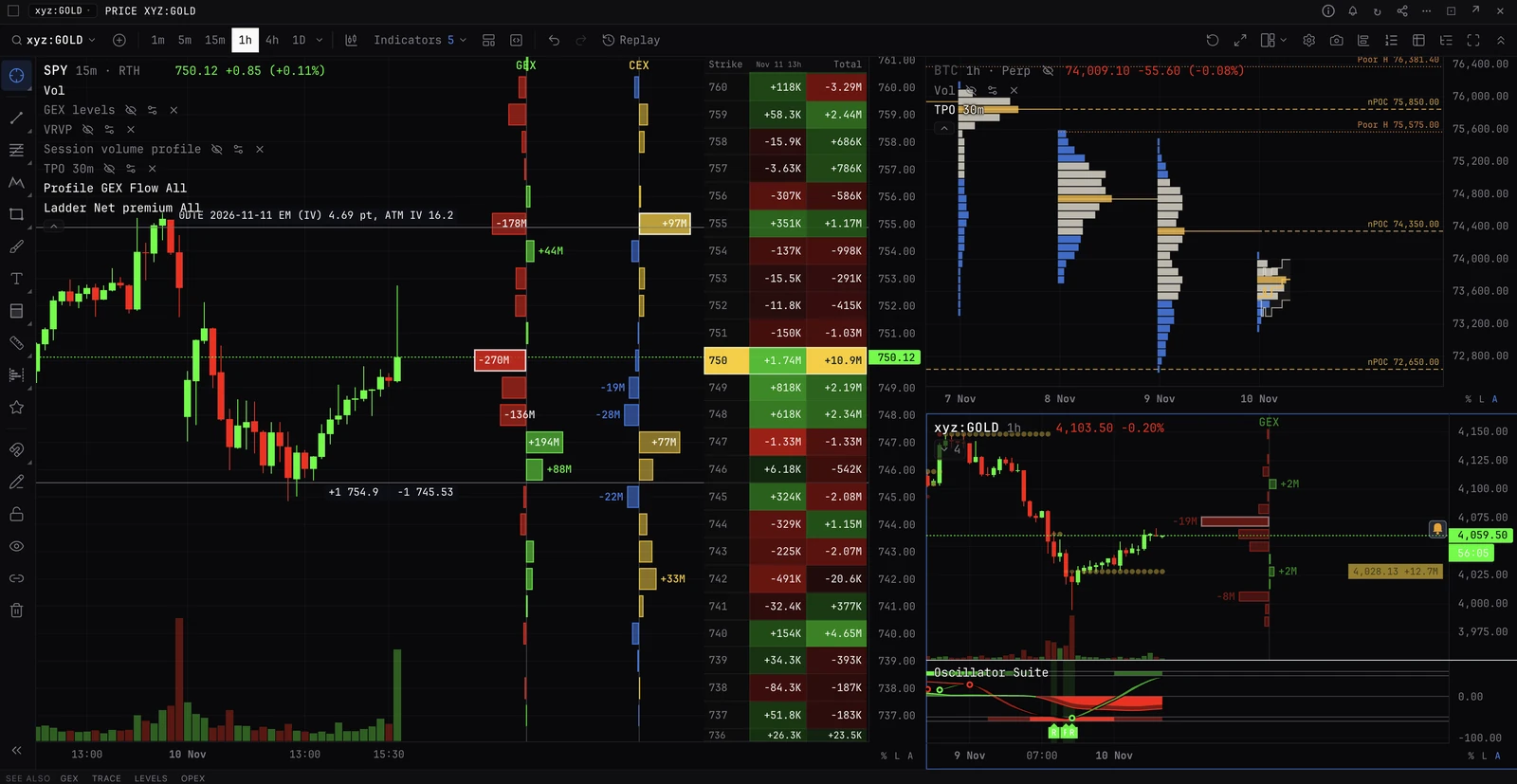
Portfolio
/portfolio, or Portfolio at the top of the trade page. Every account you trade, on every exchange, as one book in US dollars, on one page laid out the same for everyone.
PORT/portfolio; PORT in the Pro terminal; sections on the trade page
The page
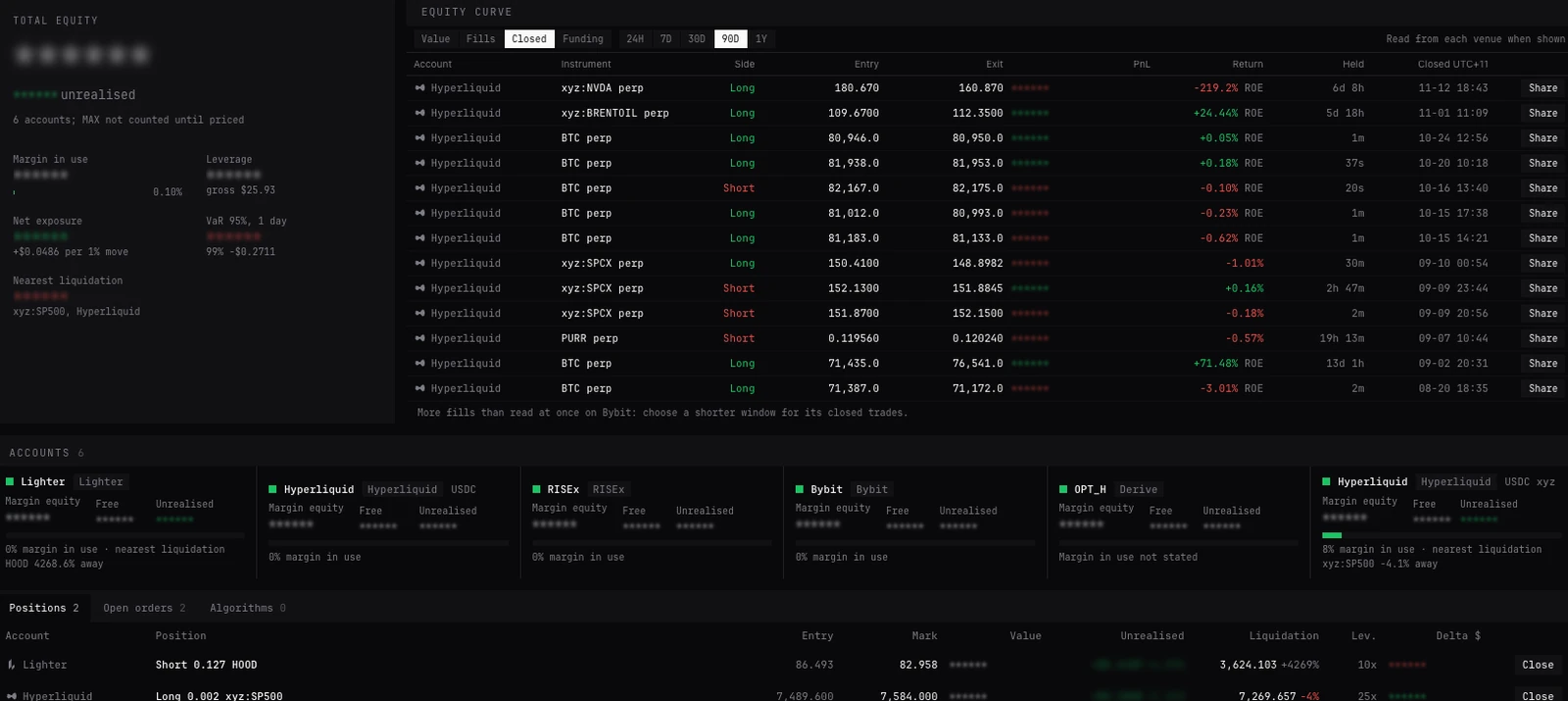
Nothing to arrange: the book’s equity large beside its curve, the figures a trader reads first under it, each account as a card, then the positions with the orders and algorithms as tabs, exposure by coin, the risk, and profit by venue, by exchange and moving collateral as tabs. Hover a section’s title for what it shows. The page scrolls down, never across.
Nothing here sends an order without the ticket: a Close or a Hedge is loaded into the page’s own ticket, to check and send. Cancels, and pausing or cancelling an algorithm, send from the page.
- All exchanges
- With accounts on more than one exchange: All exchanges, or one exchange (click it again for all). The whole page follows: every figure is worked out again from that exchange’s accounts. On a phone, a menu.
- One account
- A click on an account card shows that account alone. Its name in the bar, with x, shows every account again.
- Ticket
- An order ticket at the side of the page, for an order of your own. A Close or a Hedge opens it, loaded. Close takes it away.
- Accounts, Settings
- As on the trade page. Open in Pro opens the Pro terminal.
- The footer
- Report a problem, Feedback and the clock.
Total equity
- Total equity
- Every balance of every account shown, valued in dollars and added up: margin and spot holdings alike, stablecoins at par, coins at their price. Unrealised profit is inside the exchanges’ balances, never added again. With one exchange or one account chosen, it says whose: Hyperliquid equity, or the account’s name.
- Unrealised
- The open positions’ profit, in dollars, coloured by sign.
- N accounts
- How many accounts are counted. A holding nothing prices yet is named: not counted until priced. Before anything is in, it reads “Reading the accounts”.
The figures under it
- Margin in use
- The margin the exchanges hold against the open positions, each position’s own as stated, with a bar of its share of equity: green, amber past half, red past 80%.
- Leverage
- Gross exposure over equity, longs and shorts both counted, coins held included. Under it, the gross in dollars.
- Net exposure
- Longs less shorts in dollars, every coin. Under it, what the book makes or loses per 1% move of every coin together: the net over 100.
- VaR 95%, 1 day
- Value at risk: today’s book, with the coins held, replayed on each of the last 90 days; one day in twenty lost more than this. Under it the 99% figure; on hover, the share of equity. It reads “reading 90 days” while the closes load, and “no daily history” where there are too few.
- Nearest liquidation
- The exchange’s liquidation price closest to its mark, as the move that reaches it, red within 10%; under it the market and account. None: no position states one.
- Gamma per 1%, Vega per vol, Theta per day
- With an option held: how the delta per 1% changes as every coin moves 1%, what the options make or lose as implied volatility rises one point, and what time costs or earns them each day. The exchanges’ own figures where stated, summed.
Equity curve
Read from each exchange when shown. Value, Fills, Closed or Funding, over 24H, 7D (default), 30D, 90D or 1Y. Where a window reaches past what OKX or Binance keep (about 3 months of fills and funding), it says so.
- Value
- One account and one currency at a time: a dollar account and a BTC one on one axis would be two units on one line. With every account shown, a row each (Account, Start, Now, Change, %); choose one to draw it. Drawn: Start, Now, Change and its %, and the exchange’s own Profit over the window where it states one; a currency switch where the account has several.
- Fills
- Fills, Volume and Fees over the window, then each fill: Account, Instrument, Side, Size, Price, Fee, Role (Maker or Taker) and Time. Fills so far, with +, where older ones are not read yet: Load older.
- Closed
- Trades from flat to flat: Account, Instrument, Side, Entry, Exit, PnL, Return (ROE where on margin), Held and Closed, with Share for a PnL card.
- Funding
- Net funding, Payments and Received, then each coin: Ccy, Received, Paid, Net, Net $ and how many payments.
Accounts
A card per account, and per pool where the exchange margins several apart: Hyperliquid’s main balance, spot and each HIP-3 DEX; a Deribit currency; an OKX or Binance single-currency margin. The title counts the cards.
- The square
- Green: live. Amber: not current (connecting, or not updating).
- Name, exchange, pool
- The account, its exchange, and which of its margins where it keeps several: USDC xyz (the USDC of the xyz HIP-3 DEX on Hyperliquid), or BTC (a Deribit BTC margin).
- Margin equity
- The account’s margin equity as the exchange states it. Total equity also counts its spot holdings, so the two can differ.
- Free
- What the exchange says can still be used. Bybit and Derive state none per asset: -.
- Unrealised
- The profit of the positions this margin backs.
- The bar
- Margin in use: the exchange’s initial margin over what it measures margin against. Green, amber past half, red past 80%. Under it, N% margin in use and the nearest liquidation, or Margin in use not stated.
Positions
Every position of every account shown, as the structures they are: a package placed as one, or the options of one account, one coin and one expiry taken together and named (a bull call spread, a long straddle), on one line with ▸; click it for its legs. A perp, future or coin held is a line of its own. The tab counts them.
- Account
- The exchange’s mark and the account.
- Position
- Long or Short, the size and the market. A click opens it on Trade, on its account.
- Entry, Mark
- The exchange’s own, on a single position (a structure’s on its legs).
- Value
- Its exposure in dollars: a contract’s notional, an option’s delta times the coin’s price. Summed over a structure’s legs.
- Unrealised
- Profit since the entry in dollars, and its return on what it cost (an inverse contract’s in its coin). Under a dollar, its figures are kept.
- Liquidation
- The exchange’s price, and the move that reaches it: amber within 25%, red within 10%.
- Lev.
- The exchange’s leverage for it.
- Delta $
- Signed exposure in dollars.
- Theta
- With an option held: dollars a day.
- Close
- Loads a reduce-only market close of the exchange’s whole size into the page’s ticket, to check and send. On a leg, that leg alone. A prediction market’s close is the size held, as no exchange takes reduce-only there.
Open orders and algorithms
- Open orders
- Every order resting on every account (the Orders tab of Positions and orders, for every account at once): Venue, Account, Market, Side, Size and Price (a limit’s price, a Take profit or Stop with its trigger, or market), newest first.
- Cancel
- A limit at once. A stop or a take profit asks first: the position it protects stays open without it (Cancel stop or Keep). A second press while a cancel is on its way sends nothing.
- Algorithms
- Every algorithm running on the accounts you trade: Kind, Account, Market, Side and Done (the filled share of what it was asked to trade), with Pause, Resume and Cancel.
Exposure by coin
Each coin netted across every account and exchange, largest first: positions by their notional or an option’s delta, and coins held (a Deribit balance, a Bybit coin, a Hyperliquid spot token) by their value. A Deribit option priced in its own coin counts its delta less its value, which is already in the coin’s balance. Stablecoins are not exposure.
- Net $
- Longs less shorts in dollars. partial: part of it cannot be valued yet and is left out. -: none of it can.
- Of equity
- Net over the book’s equity.
- Short / long
- Shorts to the left of the line, longs to the right, on one scale for every coin.
- Beta
- To BTC, from 90 days of daily closes.
- Δ per 1%
- What it makes or loses as the coin moves 1%.
- Net
- The net in coins.
- Gamma, Vega, Theta
- With an option held: per 1%, per volatility point, per day.
- Venues
- Every exchange it sits on, positions and spot holdings both.
- Hedge
- A menu of every account you trade that lists a perpetual on the coin, each line the order that offsets the coin’s net (rounded to that perpetual’s step), the exchange and the account, or Below the smallest order. A choice loads it into the page’s ticket at market. Nothing is sent.
Risk if prices move
The book’s margin per account, its greeks, its profit across price moves and days, the price by volatility grid, value at risk, greeks by expiry and the positions behind them, and risk alerts. See Portfolio risk.
Profit by venue
What each account made over 24H (default), 7D, 30D, 90D or 1Y, grouped by exchange (venue): a row per account; an All accounts row for an exchange where you have several; and, when you trade on more than one exchange, an Every venue row named The book, for all of it.
- Profit
- The exchange’s own, from its account history: the change in what it says was made over the window.
- Realised
- Trades closed in the window, worked out from the fills read.
- Fees
- Paid, from the fills; a rebate counts back.
- Funding
- Received less paid.
- Net
- Realised, less fees, plus funding.
- Volume
- Traded notional in dollars.
- The last column
- N closed, reading, not read (the exchange’s reason on hover), or partial: the window holds more fills than were read, so its realised, fees and net stay out of the totals.
By exchange
Each exchange on its own line, whatever is chosen at the top: Exchange, Accts, Equity, Unrealised, Margin, Net, Gross, Lev. (gross over equity), Pos. and Nearest liq. (the coin and the move, red within 10%). Click one to show the page for it alone; again for every exchange.
Move collateral
Between an account’s own pools, where its exchange keeps several: on Hyperliquid, the Main perp balance, Spot and each HIP-3 DEX. Choose the account, from, to and the amount (to the cent), then Move: it asks first. Money between exchanges is your wallet’s to move: a trading key cannot withdraw.
When to look at what
- Before adding size. Margin in use and each account’s bar: the account an order draws on, not the book, is what its exchange liquidates.
- After hedging. Net exposure and Exposure by coin: a coin long on one exchange and short on another should net near zero if hedged.
- In a fast market. Nearest liquidation and Liquidation on each position: amber within 25%, red within 10%.
- Once a day. VaR against equity, and the equity curve’s funding against its value: what holding cost.
- At the end of the week. Profit by venue: fees and funding against realised profit, what trading cost you.
The PORT panel
The same book as a panel in the Pro terminal: Positions, Exposure, Risk, Balances, Orders, Fills, History and Accounts, for All accounts or one. History is the equity curve’s Value, Fills, Closed and Funding. It sends nothing: orders are cancelled from Positions and orders or the Portfolio page.
Questions
Why does Total equity differ from an account card?
Total equity counts every balance, spot holdings at their price included. A card shows margin equity as the exchange states it.
Why is a figure -?
The exchange did not state it, or nothing has been read yet. A figure the exchange does not give is never shown as zero.
How are coins priced?
Stablecoins at par. A coin at an exchange’s own mark for a perpetual on it, from the deepest exchanges first. A coin nothing prices is left out and named.
Why does the VaR here differ from the one in Risk?
The headline counts the coins held with the positions. Risk follows its Positions or With coins choice, and can add the order in the ticket.
Does Close or Hedge send an order?
No. Each loads the page’s ticket. You check it there and send.
Why does Profit by venue say partial?
Only a page of fills is read at a time, to keep within the exchange’s read limits. Where the window holds more, realised, fees and net are of part of it and left out of the totals. Choose a shorter window.
Can I rearrange the page?
No: it is one designed page. Its sections can be put on the trade page as panels, from + Panel, Portfolio, and arranged there.
More
- Portfolio risk. The curve, the grid, value at risk and alerts.
- All your accounts in one place. What one book means, and hedging across accounts.