


Portfolio risk
Risk if prices move, on the Portfolio page; Risk in PORT; Risk (curve, grid, value at risk) on the trade page. What can hurt the book, and how badly.
PORTPortfolio page, PORT in Pro, and the trade page
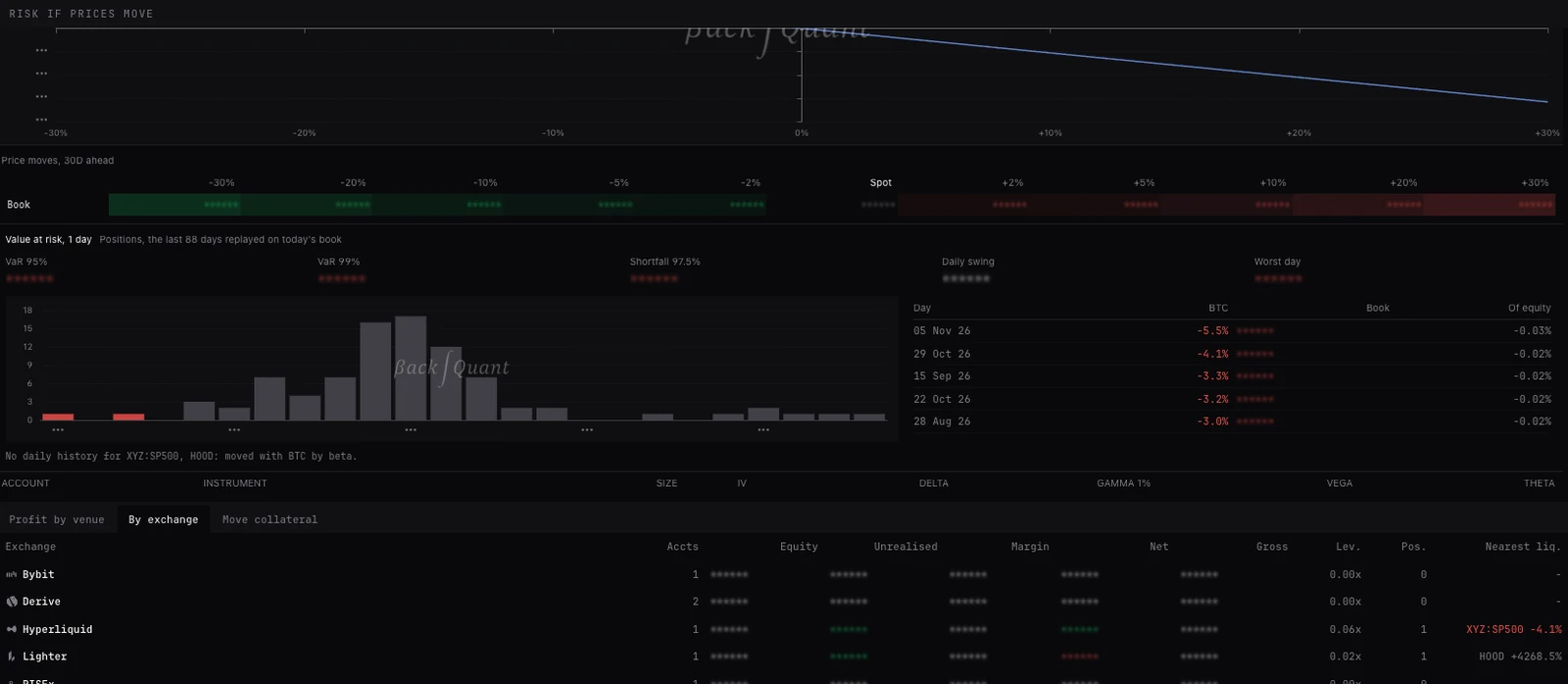
What it is
Every position and coin held, revalued as prices move, volatility shifts and days pass. It follows what the page shows: all exchanges, one exchange, or one account. It sends nothing: the Hedge loads the ticket.
The figures are recomputed at most once a second, the margin-call estimate every five seconds, and the curves each minute as expiries come nearer. An account still loading says so in amber: what it holds is not counted yet.
Margin, per account
A card per margin the account keeps, as on Accounts.
- Equity
- The margin’s equity in dollars.
- Margin used
- The exchange’s own initial margin and its share, amber from 50%, red from 80%, with a bar. Where the exchange states none: the equity it says is no longer available, else the positions’ own margin.
- Margin ratio
- Maintenance margin over what the exchange measures margin against: 100% is liquidation. The exchange’s own where it states one; else worked out, and marked est.
- Nearest liquidation
- The nearest liquidation price the exchange states for this account’s positions, as a move, red within 10%. None stated where there is none.
- Margin call, est.
- The move down and up at which this account’s equity would fall to the maintenance margin its exchange states today, every coin moved by its beta to BTC, searched to ±80%. None within ±80%; No positions; on a HIP-3 DEX, Per position: see each liquidation price. An estimate: the exchange’s own requirement moves with price and volatility.
- Move back to main
- On a HIP-3 DEX card with nothing held, for the account the ticket trades: its collateral back to the main balance (or spot), all of it, in one click.
The controls
- Coin
- All (every coin moved together, BTC by the move and each other coin by its beta times it) or one of the eight largest. Unchosen: the coin a position is open on, All where there are several.
- Positions, With coins
- Positions alone (default), or with the coins held: collateral such as Deribit’s BTC can dwarf the shape of the options.
- Add staged
- Shown when the ticket beside it holds an order: the order as if filled at its price (a limit’s, else the touch), counted with what crossing to that price costs against the mark. With staged shows it is in; a faint Without staged line keeps the book without it. An order already sent is never staged on top of its fill.
- Vol
- With an option held: every option’s implied volatility shifted -10, -5, IV (as it is), +5 or +10 points.
- Horizon
- 1D, 7D (default), 30D, or Expiry: a moment past the last option held, every option at what it pays then. With no option held, Expiry is 30 days.
The figures
- Delta
- Dollar delta of the coin chosen (its coins on hover). On All: Delta, BTC terms, each coin’s dollar delta times its beta to BTC; coins with no beta count one for one, and are named.
- Gamma 1%
- With an option held: how the dollar delta moves when the coin moves 1%. Gamma times the price squared, over 100.
- Vega
- Dollars per volatility point.
- Theta
- Dollars per day.
- Worst -30% to +30%, Best
- The lowest and highest point of today’s curve across the range.
- Breakeven
- Where the curve at the horizon crosses zero. Today’s curve is level at no move by definition; the breakevens that mean something have the time decay in them.
Hedge and Alerts
- Hedge
- With one coin chosen: Hedge: sell 0.42 BTC · BTC-PERP, for one. The perpetual or future on the coin, on the ticket’s account (its current market if it is one, else an inverse perpetual, else a perpetual), sized to the delta and rounded to its step, loaded into the ticket as a limit at the touch. Nothing is sent.
- Why not
- Beside it when it cannot: Choose one coin to hedge; Choose an account in the ticket to hedge on; the account lists no perpetual on the coin; The delta is below the smallest order.
- Alerts
- The risk alerts, with how many are on and, in red, how many are firing.
The curve
The book’s gain or loss if the coin moved by the percent along the bottom, from -30% to +30%: Now, solid; the horizon, dashed; Without staged, faint. Red dashed lines mark liquidation prices (Liq and the market); amber ones each account’s margin-call estimate. Dots on the horizon curve are its breakevens. Hover for the move, the price there and each line’s figure. Positions that cannot be revalued are counted under it and left out.
The grid
Price by volatility, at the horizon: the gain or loss at -30%, -20%, -10%, -5%, -2%, Spot, +2%, +5%, +10%, +20% and +30%, for each volatility shift (-10, -5, IV, +5, +10), shaded green or red by size. Without an option held, volatility moves nothing: one row, Book, titled Price moves.
How a position is revalued
- Option. Repriced with Black-76 (the standard model for an option on a future’s price) at the moved price, its implied volatility shifted, its expiry nearer, against its value now. The volatility is the one its mark gives; past expiry it is worth what it pays.
- Linear perp or future. Its coins times the price move.
- Inverse contract. Sized in dollars, settled in the coin: its dollars times the new price over the old, less one.
- Coin held. Its value times the move (With coins).
- Not in it. Fees, funding and the exchange’s own margin model: an estimate for reading the shape of the book.
Value at risk
Value at risk (VaR), 1 day: today’s book replayed on each of the last 90 days, over the whole book whichever coin is chosen, with or without the coins held and the staged order as chosen above. Each coin moves as it did that day (BTC’s move times its beta where BackQuant has no daily close for it), and makes its dollar delta times the move plus its gamma’s share, 50 times Gamma 1% times the move squared, so a long option gains both ways. At least 30 days are needed.
- VaR 95%
- One day in twenty loses more than this: over 90 days, the fifth-worst day replayed. Its share of equity on hover.
- VaR 99%
- One day in a hundred loses more than this. Over 90 days, the worst day.
- Shortfall 97.5%
- The average loss of the worst 2.5% of days.
- Daily swing
- One standard deviation of the book’s day, in dollars.
- Worst day
- The worst replayed day, with its date and BTC’s move on hover.
- The spread
- Every day replayed, counted into bars by profit or loss; the days past the 95% line in the loss colour.
- Worst five
- Day, BTC’s move, what the book would have made, and its share of equity.
- Price moves only
- An option’s vega is not in it: BackQuant keeps no daily implied volatility per expiry. Said under it where options are held.
Beta to BTC
The slope of a coin’s daily log returns on BTC’s over the last 90 days, from BackQuant’s daily closes, with at least 30 days in common. Read for the 15 largest holdings and refreshed every few hours; the rest move one for one with BTC, and are named.
By expiry and the positions
- By expiry
- With an option held: Expiry, Pos., Delta, Gamma 1%, Vega and Theta per expiry, nearest first, perpetuals last as Perpetual. Where the book’s gamma, vega and theta sit.
- The positions behind it
- Account (In the ticket for a staged leg), Instrument, Size, IV, Delta in coins, Gamma 1%, Vega and Theta. Greeks the exchange states say so on hover.
Risk alerts
Alerts, in Risk. Watched in this browser while a BackQuant tab is open, terminal or trading page: your accounts are read here and nowhere else. Kept on this device. Each fires once when it starts to hold, and again only after it has stopped: a position sitting near liquidation is one alert. With a sound (Sound, on by default: its own switch, apart from the fill sound in Trading settings, which starts off), and as a browser notification where the browser allows them (Allow browser notifications).
| When | In | On | Default |
|---|---|---|---|
| Liquidation within | % | Any position, or one coin | 10 |
| Margin used above | % | The book | 80 |
| Delta beyond | $ | The book, or one coin | 1000 |
| Gamma 1% beyond | $ | The book, or one coin | 1000 |
| Vega beyond | $ | The book, or one coin | 1000 |
| Theta costs more than | $ a day | The book, or one coin | 1000 |
| Unrealised loss beyond | $ | The book | 1000 |
- In
- %
- On
- Any position, or one coin
- Default
- 10
- In
- %
- On
- The book
- Default
- 80
- In
- $
- On
- The book, or one coin
- Default
- 1000
- In
- $
- On
- The book, or one coin
- Default
- 1000
- In
- $
- On
- The book, or one coin
- Default
- 1000
- In
- $ a day
- On
- The book, or one coin
- Default
- 1000
- In
- $
- On
- The book
- Default
- 1000
- Margin used above
- Watches every account and fires on the one using the most of its equity as margin.
- Unrealised loss beyond
- Across every account counted.
- Add
- Adds the rule, on. Its checkbox turns it off and on; Remove deletes it.
- Under each rule
- Firing, in red, with what holds; else Now, with the figure it watches.
When to look
- Before an options trade. Stage it in the ticket and Add staged: the curve and grid with it, and the faint line without.
- Into an event. Vol +10 and the horizon: what a volatility spike does at each price.
- Near expiry. Expiry and By expiry: where the gamma sits, and what the book is worth when the options settle.
- Any time. Where the curve turns down (the move that hurts), and a worst case larger than an account’s free margin.
Questions
Why are the greeks different from my exchange’s?
Where the exchange states greeks for a position (Deribit, Derive) they are its own. On Bybit and OKX they come from the option’s mark through Black-76; a mark rounded to the tick can imply a slightly different volatility.
Is the margin call the exchange’s?
No: an estimate, from today’s stated maintenance margin. The liquidation prices are the exchange’s own.
Why is VaR missing?
It needs BTC’s daily closes and at least 30 days of them, and something held. Not enough daily history for the coins held says so.
Does Hedge here use another account?
No: the ticket’s account. To hedge on another account, use Hedge in Exposure by coin, which offers every account that lists a perpetual on the coin.
Will alerts fire with the browser closed?
No. They are watched in this browser, so a BackQuant tab must be open. Nothing about your accounts is watched on a server.
Why does With coins change the curve so much?
Coins held as collateral move with the price one for one, and can be far larger than the positions. Positions alone shows the shape of the trades.
More
- Portfolio. The page the risk section sits on.
- How delta hedging and greeks work. Where every greek and risk figure comes from.