


Risk Reversal
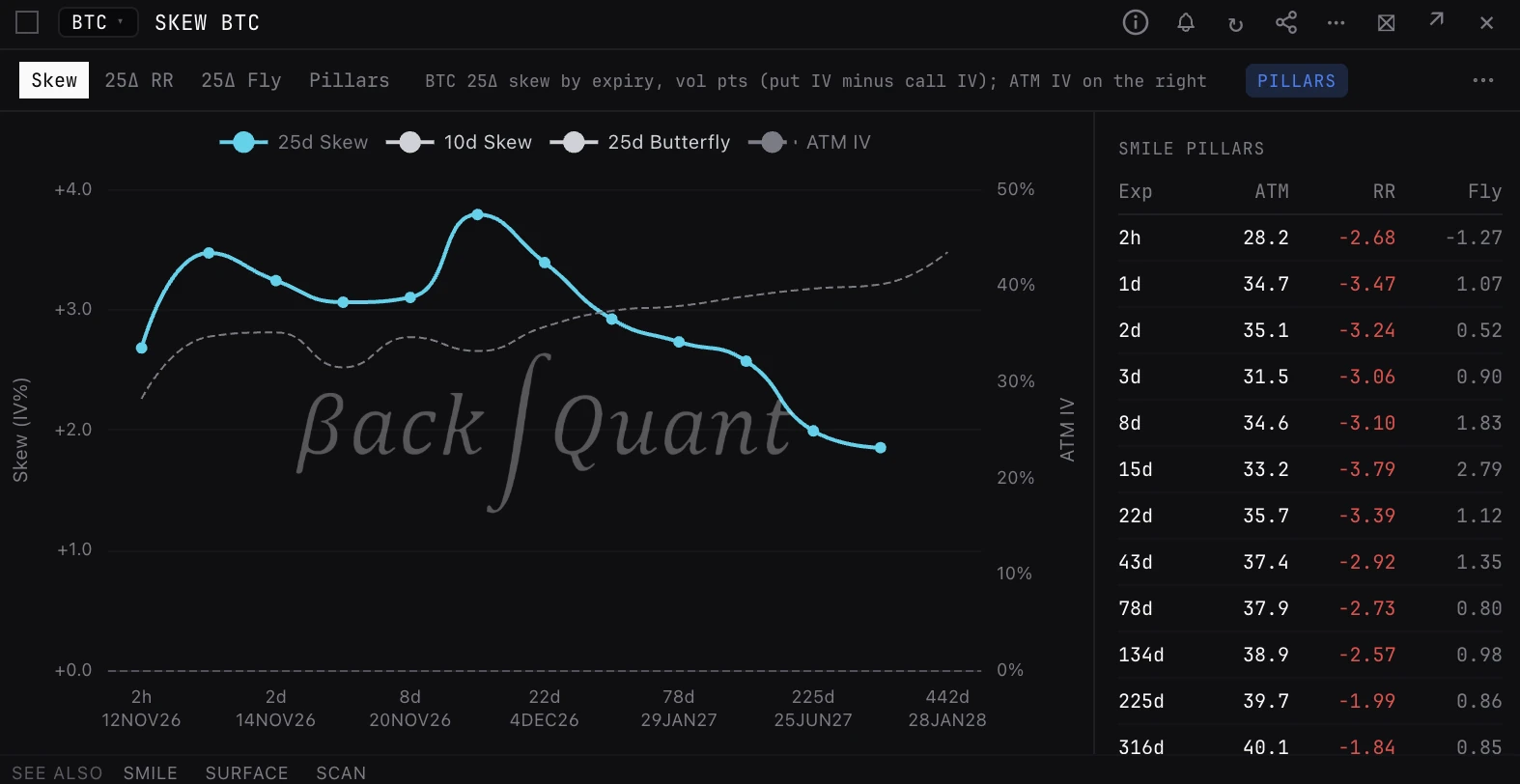
Call implied volatility minus put implied volatility at the same delta, usually 25 delta. Negative means puts cost more than calls, the usual sign of downside hedging; positive means upside calls are in demand. As a trade, a risk reversal buys one side and sells the other, so it is a cheap way to express direction.
Related terms
DeltaAn option Greek measuring how much the option price changes per one-dollar move in the underlying. A call with delta 0.5 gains roughly fifty cents per one-dollar rise in spot. Delta also approximates the probability the option finishes in-the-money.RangeA price regime bounded by clear support and resistance, with mean-reverting behaviour inside. Ranges are most likely in positive-gamma environments and tend to compress as expiry approaches.Realized VolatilityThe volatility actually observed in the underlying over a window of time, calculated from historical price changes. The gap between implied and realized volatility is the volatility risk premium: historically, implied has usually run above realized, because option sellers want paying for tail risk. It is a tendency, not a guarantee, and it can flip sharply when markets are stressed.RegimeThe character of price action over a period: trending or ranging, high-vol or low-vol, positive or negative gamma. Regime classification is the single most important input to strategy selection. A signal that works in one regime often fails in another.ResistanceA price level where selling pressure has historically appeared and price has stalled or reversed. Strong resistance often coincides with call walls, max pain, prior highs, or round numbers. A confirmed break of resistance often produces follow-through.
See Risk Reversal live on the terminal.
BackQuant is the analytics terminal for equity and crypto options. GEX walls, dealer positioning, options flow, and the full derivatives context - one product.