

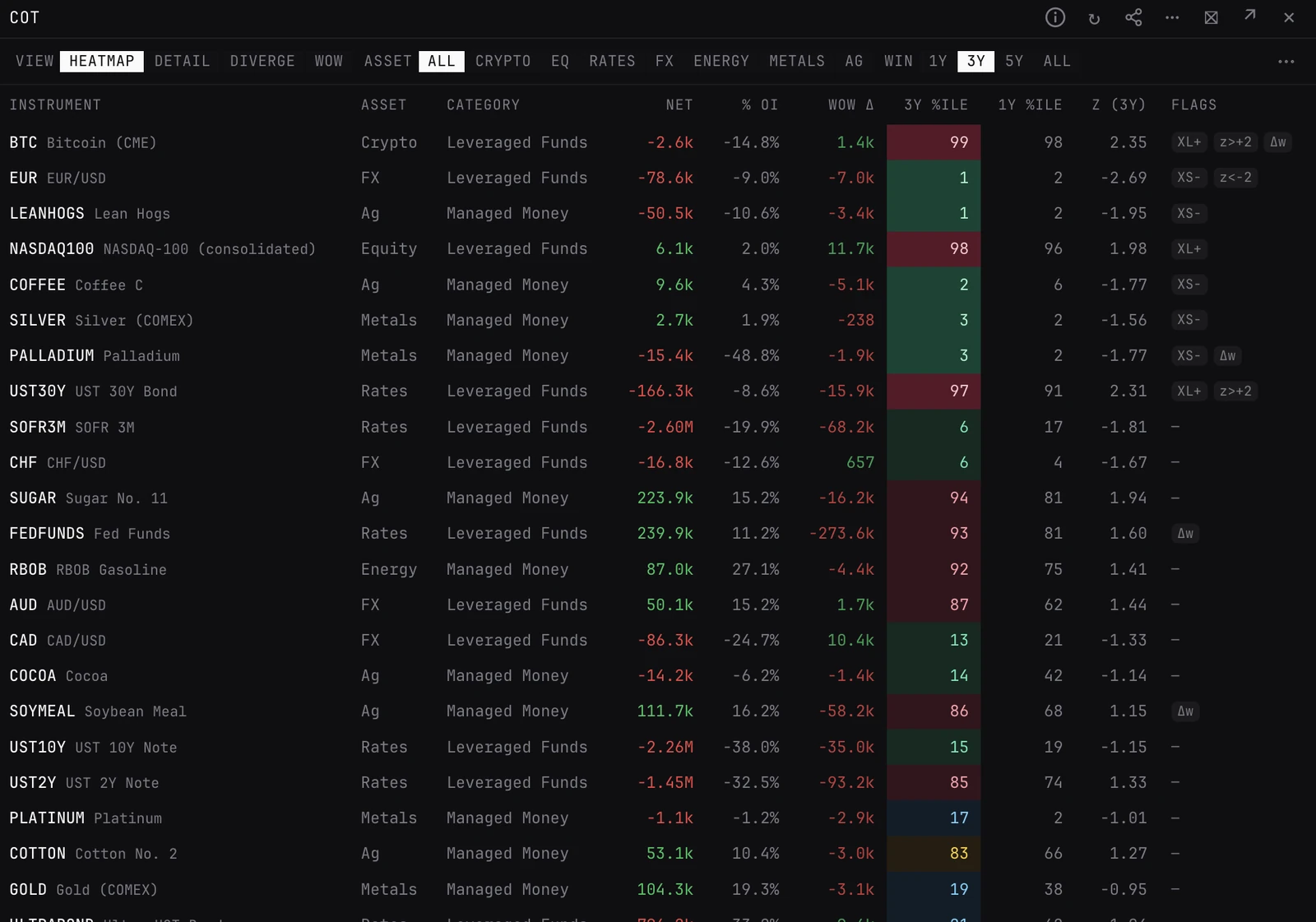
COT Net Positioning
From the weekly Commitments of Traders report published by the CFTC: the long contracts minus the short contracts that one group of traders, such as leveraged funds or asset managers, holds in a futures market. On its own the net number says little; compared with that market’s own history, as a percentile or z-score, it shows when a position is crowded. Crowded positions can unwind hard when the move turns, though they can stay crowded for weeks.
Related terms
FuturesA standardized contract to buy or sell an asset at a set price on a future date. Crypto futures with fixed expiries exist alongside perpetual futures (perps) which never expire. Quarterly futures concentrate the most open interest.LeverageThe ratio of position size to margin posted. 10x leverage means a 10% adverse move wipes out the position. Crypto perpetual exchanges commonly offer up to 100x leverage. Higher leverage means smaller liquidation thresholds and faster cascades.LongA position that profits when price rises. Buying spot, going long a perp, owning a call, or being short a put are all long positions. Opposite of short.ShortA position that profits when price falls. Selling spot, going short a perp, owning a put, or being short a call are all short positions. Short positions in crypto carry tail risk because upside is unbounded.PercentileWhere a reading sits among past readings of the same series, from 0 (the lowest) to 100 (the highest). The 95th percentile is higher than 95% of the history in the window. Percentiles let very different markets be compared on one scale, because each is measured against its own past.
See COT Net Positioning live on the terminal.
BackQuant is the analytics terminal for equity and crypto options. GEX walls, dealer positioning, options flow, and the full derivatives context - one product.