

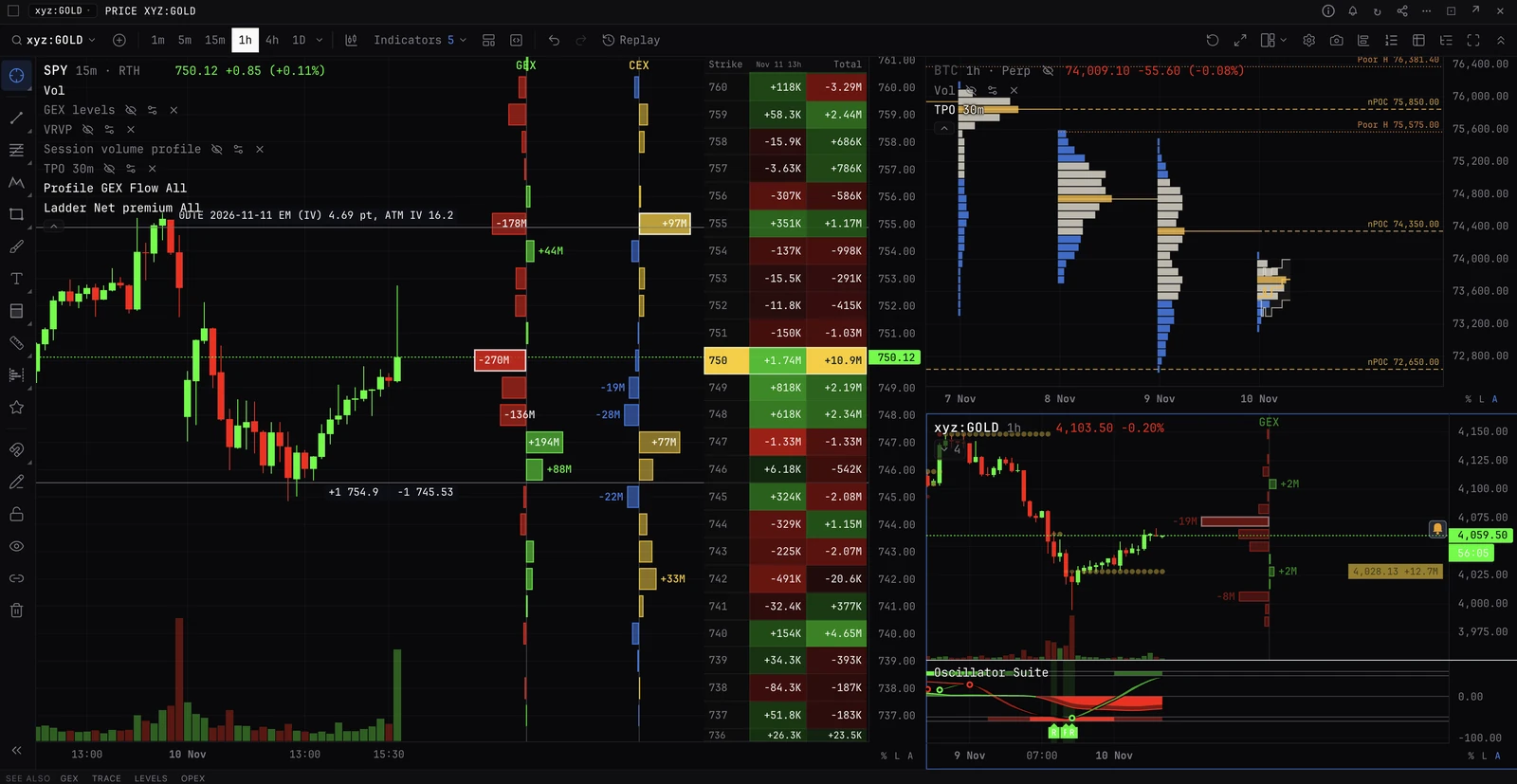
Block Trade
One large options trade printed in a single piece, often arranged between two parties away from the screen. Blocks matter because one trader moved a lot of size at once, and the strike and expiry chosen say what that trader is positioning for. On US options, a block is told apart from a sweep, which is one order spread across several exchanges at once.
Related terms
ExpiryThe date and time at which an options contract settles. After expiry, an option pays out its intrinsic value or expires worthless. Crypto options on Deribit expire Fridays at 08:00 UTC.RangeA price regime bounded by clear support and resistance, with mean-reverting behaviour inside. Ranges are most likely in positive-gamma environments and tend to compress as expiry approaches.SweepAn options order that takes the quotes on several exchanges at once to get filled immediately rather than wait for a better price. Sweeps signal urgency, which is why they are tracked separately from single prints and blocks. A sweep of $1M or more is often called a golden sweep.BackwardationA market structure in which near-dated contracts trade at higher prices (or higher implied volatilities) than longer-dated contracts. In futures, backwardation often signals near-term scarcity. In options IV term structure, backwardation signals an imminent catalyst or active stress in the market.BasisThe difference between a futures or perpetual price and the underlying spot price. Positive basis means futures trade at a premium to spot; negative basis (sometimes called inverse basis) signals near-term selling pressure or fear. Cross-venue basis arbitrage is a core strategy in crypto market making.
See Block Trade live on the terminal.
BackQuant is the analytics terminal for equity and crypto options. GEX walls, dealer positioning, options flow, and the full derivatives context - one product.