

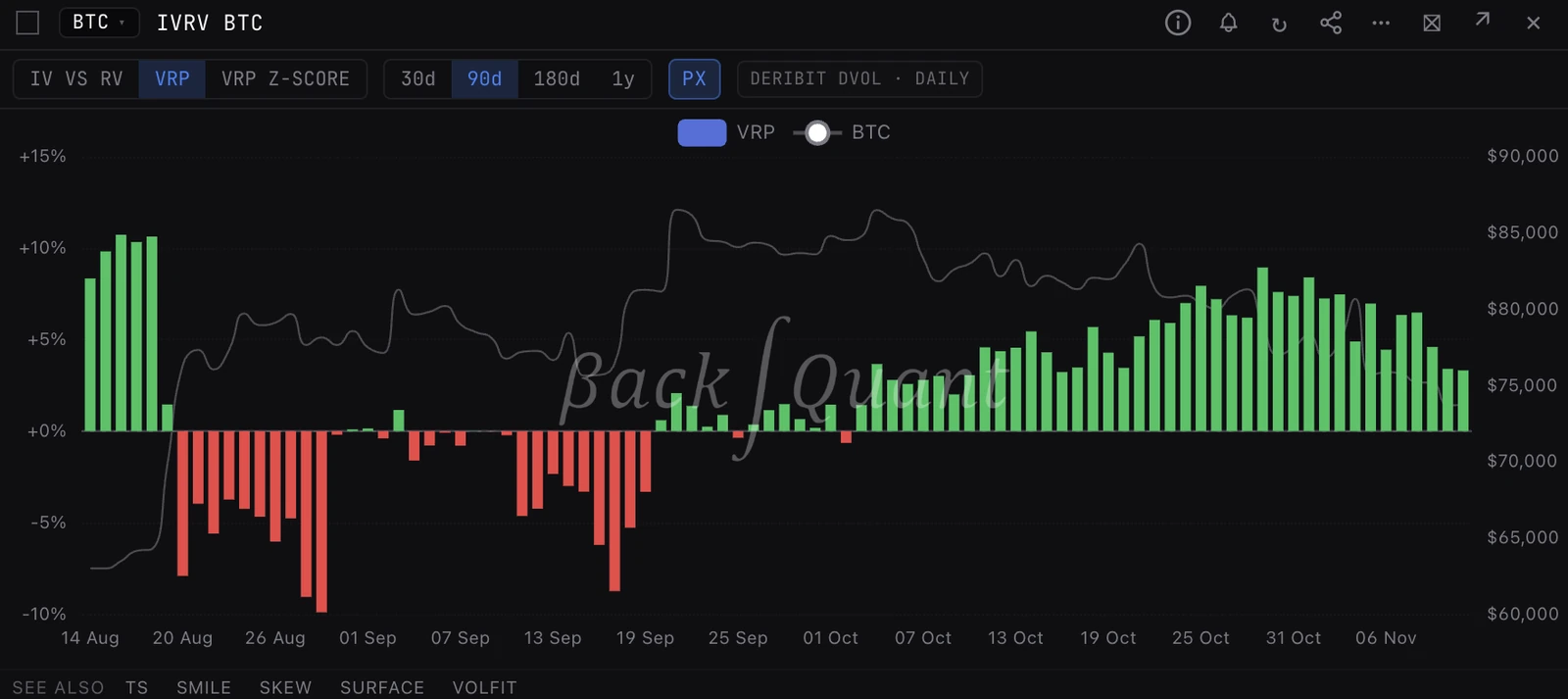
Volatility Risk Premium
The gap between implied volatility and the volatility that is later realized. Historically, implied has tended to sit above realized over long horizons, because option sellers want paying for tail risk, so the premium is usually positive. It is a tendency, not a promise of profit: it can vanish or invert in stress regimes, and selling options carries large losses when it does.
Related terms
LongA position that profits when price rises. Buying spot, going long a perp, owning a call, or being short a put are all long positions. Opposite of short.PremiumThe price of an option, paid by the buyer to the seller. Premium consists of intrinsic value plus time value. In a separate sense, basis premium refers to futures or perp prices trading above spot.RegimeThe character of price action over a period: trending or ranging, high-vol or low-vol, positive or negative gamma. Regime classification is the single most important input to strategy selection. A signal that works in one regime often fails in another.VannaA second-order Greek measuring how delta changes with implied volatility. Summed across a dealer book (vanna exposure, VEX), it says how much delta dealers must buy or sell every time vol reprices. Vanna matters most when IV shifts fast, during news, vol spikes or vol crush, and is a recognised cause of post-event drift in spot.VegaA first-order Greek measuring an option’s sensitivity to a one-percentage-point change in implied volatility. Long options are long vega; short options are short vega. Vega is highest for at-the-money options on longer expiries.
See Volatility Risk Premium live on the terminal.
BackQuant is the analytics terminal for equity and crypto options. GEX walls, dealer positioning, options flow, and the full derivatives context - one product.