

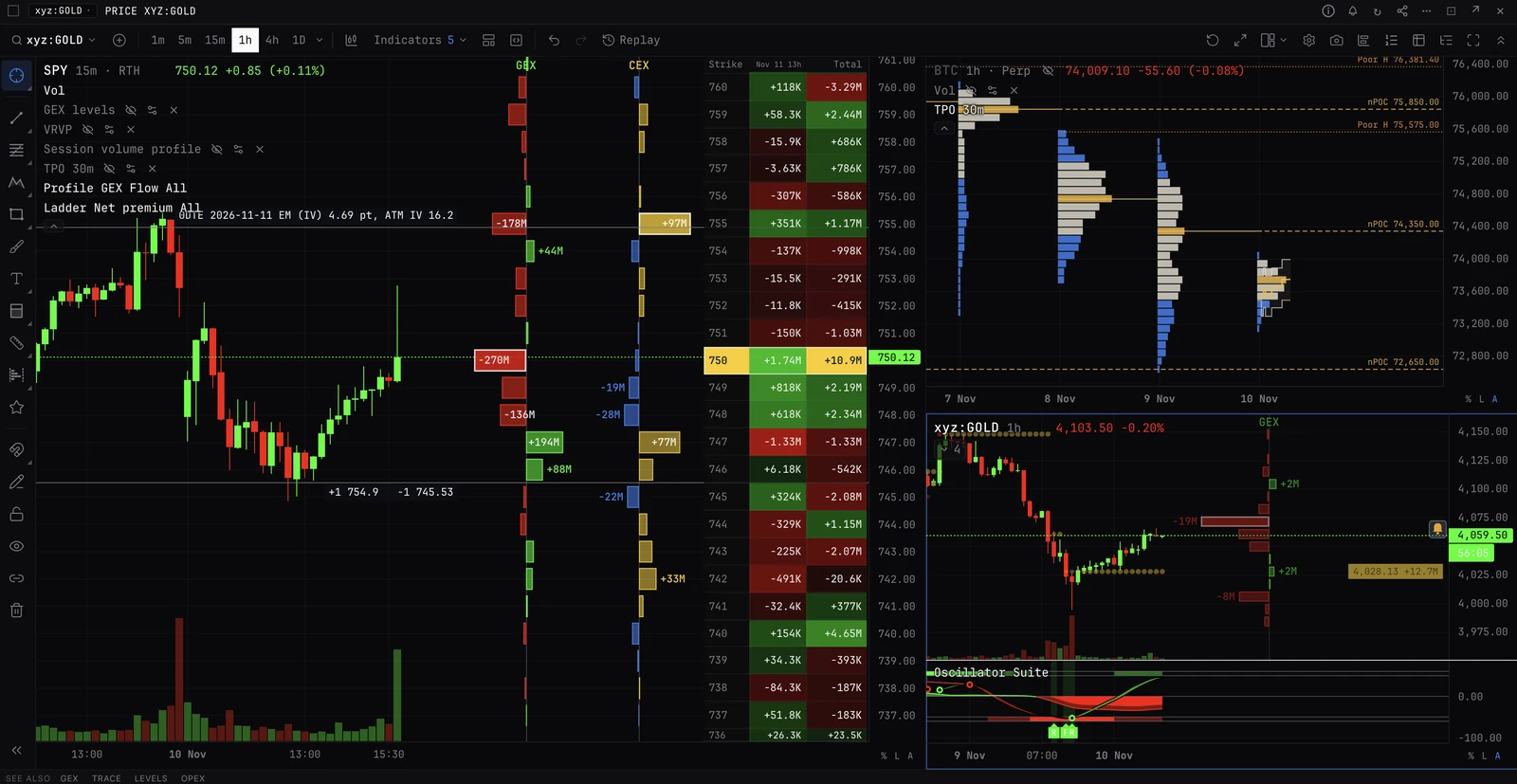
CVD (Cumulative Volume Delta)
The running sum of aggressive buying minus aggressive selling. CVD reveals which side is consistently lifting offers or hitting bids. Divergences between CVD and price are a classic exhaustion signal: when price makes a new high but CVD does not, the rally is being absorbed.
Related terms
Call OptionA contract giving the holder the right (but not the obligation) to buy the underlying at a fixed strike price before or at expiry. Buyers profit when the underlying rises above the strike plus premium paid. Sellers collect premium and have an obligation to deliver if exercised.Call WallThe strike with the largest concentration of dealer-positive gamma above the current spot price. Acts as resistance because dealers progressively sell underlying as price approaches it. Call walls are often the dominant ceiling into options expiry.CharmA second-order Greek measuring how an option's delta changes as time passes, with price and vol unchanged. Summed across a dealer book (charm exposure, CEX) it is the hedge the clock alone asks of dealers, in dollars of delta per day. It grows into expiry, which is why charm flows are strongest in the last hours before a large settlement.ColorA third-order Greek measuring the rate of change of gamma with respect to time. Rarely traded directly but matters for dealer books holding large 0DTE inventory because gamma can swing dramatically in the final hours.ContangoA market structure in which longer-dated contracts trade at higher prices (or higher implied volatility) than nearer-dated. In futures, contango is the normal carrying-cost state. In options IV term structure, contango is the default and reflects cumulative uncertainty over time.
See CVD (Cumulative Volume Delta) live on the terminal.
BackQuant is the analytics terminal for equity and crypto options. GEX walls, dealer positioning, options flow, and the full derivatives context - one product.