VWAP, A Practical Guide
A breakdown of the VWAP's mechanics, behavior and practical applications.
1.0 Introduction
If you’ve spent any time studying markets, you’ve probably come across the idea of a “moving average”. Since every small movement in the market is dictated by hundreds to thousands of transactions, the moving average has proven to be a tried and tested method of filtering the “noise”, and deriving an average price with respect to time. The VWAP is another effective method of doing exactly that-filtering out the noise. But instead of averaging the price over a specific period of time, the VWAP takes a weighted average of price with respect to the volume transacted in the market. Price levels with larger participation (volume) are deemed more significant, while prices with lower levels of volume have less significance in the derivation of VWAP.
        VWAP = Cumulative Typical Price x Volume / Cumulative Volume
            where:
                Typical Price = High Price + Low Price + Closing Price / 3
                Cumulative = Total trades since the trading session opened
2.0 A Quick Comparison
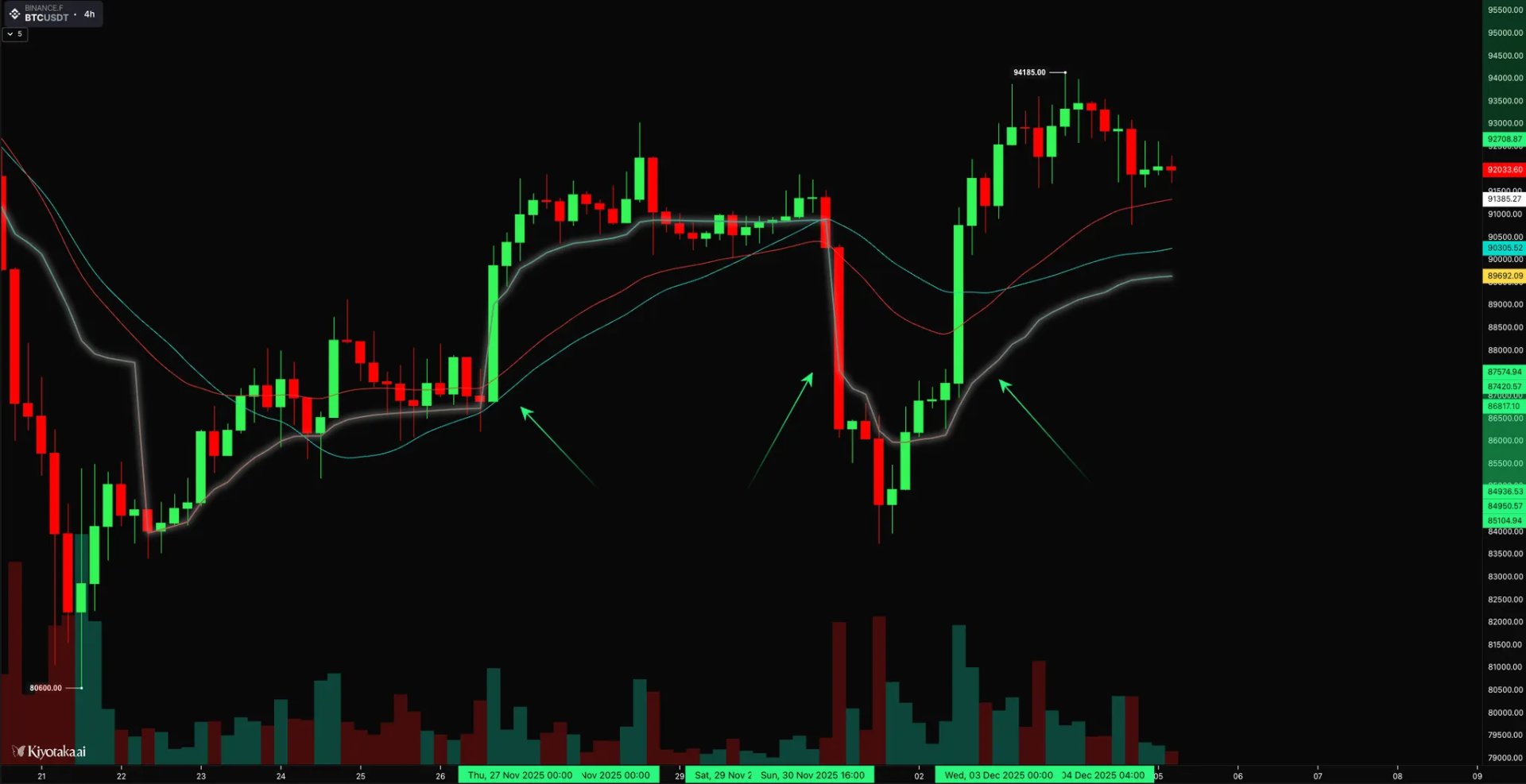
The following images contrast the nature of VWAP (glowing) with a simple moving average (SMA) in red, and exponential moving average (EMA) in green with a 26 candle look-back.
You can see that the VWAP tends to be “stickier” to price, with sharper rate changes aligning with high volume impulsive candles, while low volume zones tend to push the VWAP sideways
3.0 Why VWAP Matters
3.1 Filtering Noise and Visualising Value
Markets are chaotic and full of randomness - a product of human emotion and systematic execution. VWAP helps anchor you to reality by highlighting prices where the bulk of trading volume has occurred and visualizing what prices are considered to be “fair value” based on the level of conviction displayed by market participants.
Consider this analogy: In a given day, the average speed of traffic might be 100 km/h if you just sample a few cars, but if you weight it by how many cars are actually moving at each speed (volume), you get a better sense of the flow—maybe its closer to 95 km/h because high volume rush-hour clusters slow things down. VWAP essentially does this for price, helping you spot when the market is "overextended" (trading far from VWAP) or consolidating around value. Note that the market is not obligated to respect, or return the VWAP. It is simply a record of where past participants have acted. We’ll touch more on some practical applications in the coming sections.
3.2 Anchoring the VWAP for Precision
As you explore the VWAP, it can be a worthwhile pursuit to reset the VWAP at key levels in the market. This customization makes it adaptable to various assets, timeframes, and trading styles.
Some key levels include:
- Session Opens (e.g. New York Session)
- UTC Open
- Key Market Structure Levels
4.0 Trading Applications
4.1 Identifying Market Shifts
Studying the VWAP’s relationship to price action can provide traders insight toward significant shifts in the market, which may lead to continued price action trends.
The image below highlights impulsive moves where price was previously ranging close to the VWAP, before extending away from the VWAP and ultimately leading to trend extension.
If price is above VWAP, the market is trading at a premium relative to where most business has been done. This can signal bullish strength and if volume follows through, you can expect to see bullish continuation.
If price is trading below the VWAP, the market is trading at a discount relative to where most volume has transacted. If sellers are persistent enough, you can expect to see downward continuation. Note that no single tool will provide traders with all the answers. They must be used in confluence with relevant data to build strategies which stack the odds of success in your favour.

4.2 VWAP Deviations
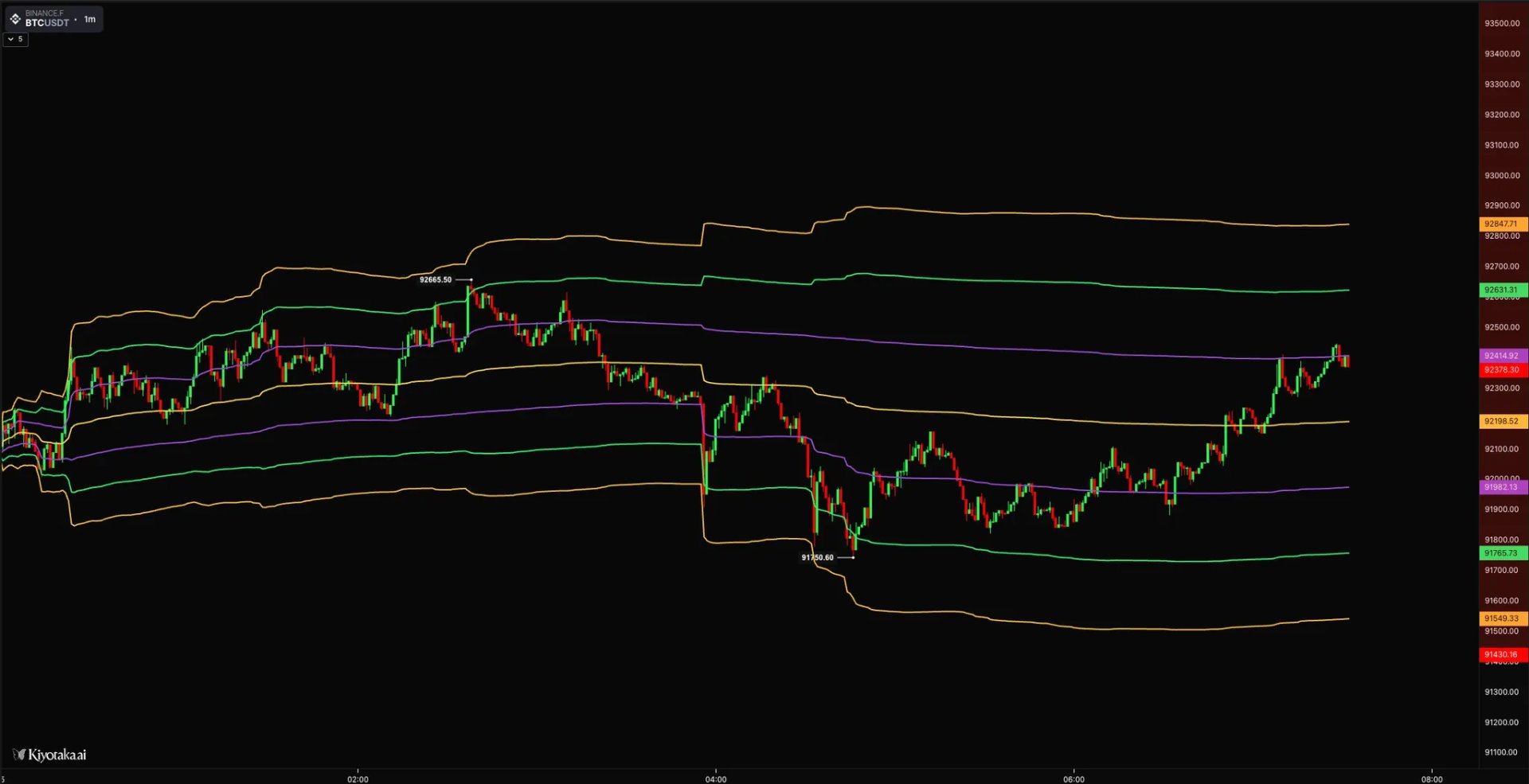
In addition to the standard VWAP, the first, second and third standard deviations of VWAP are commonly used to visualize when price has likely “overextended” above and below its volume-weighted average, and may begin to revert back to the mean.
4.3 Strategy Generation
As you experiment, remember VWAP's power multiplies when paired with other tools—no one indicator rules them all. Stacking a confluence between order flow tools can be especially useful for understanding the "why" behind price moves and forming reasonable expectations where price may go next. Some of these tools are as follows:
4.3.1 Cumulative Volume Delta
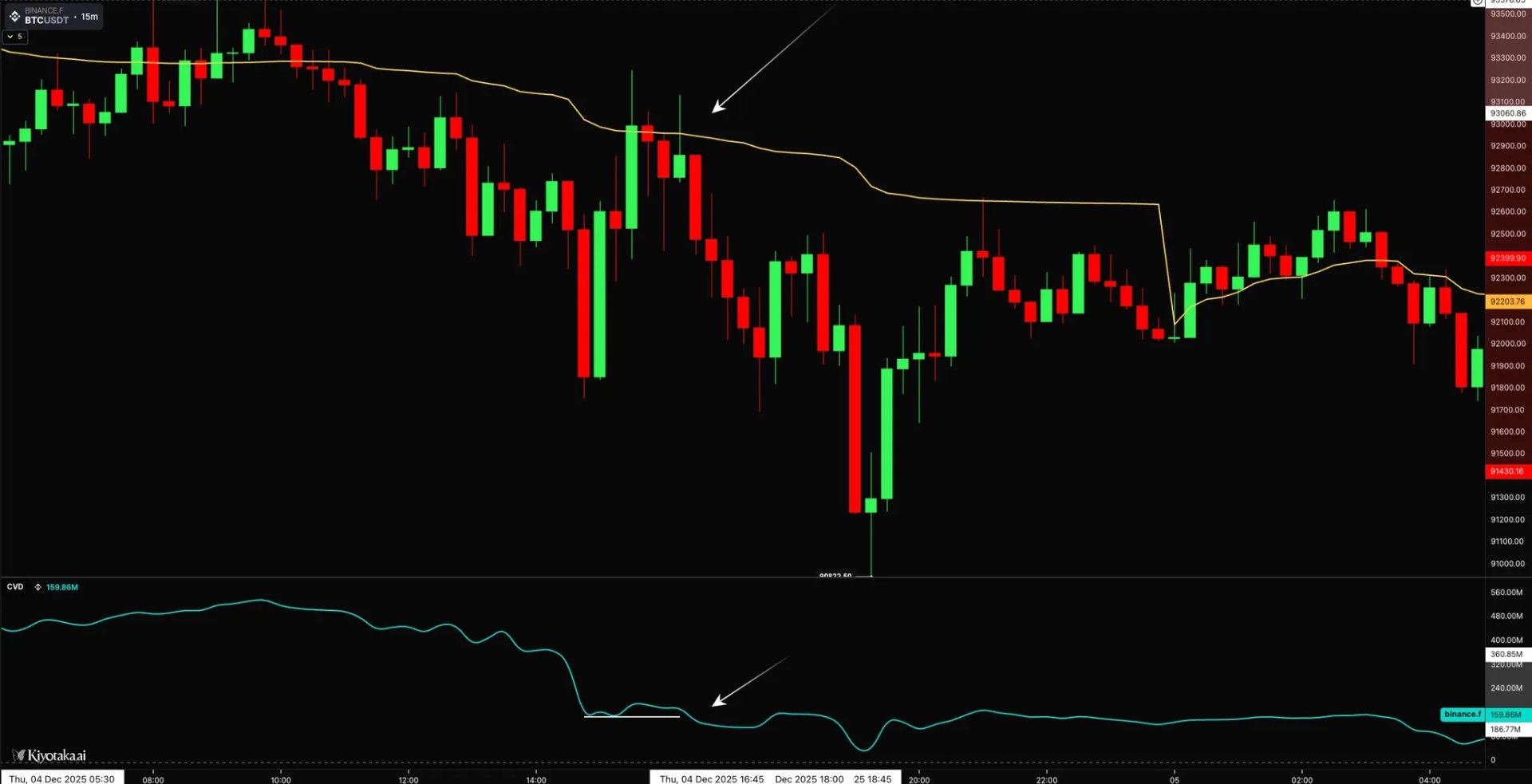
Tracks the net difference between buying and selling volume. If CVD is rising while price hugs above VWAP, it confirms bullish conviction. Use this for trend-following: Enter longs on pullbacks to VWAP with positive CVD divergence, setting stops below for risk control.
- In this example, price is in a downtrend after pushing down through the VWAP. Then, price aggressively reverts back up to the VWAP. At this moment in time, it can be useful to analyze order flow to form an expectation of where price may go next. Price begins to roll over before extending down from the VWAP once again. Additionally, CVD makes a lower low, so now it's evident that sell-side aggression has picked up once again. Price continues the downtrend.
4.3.2 Volume Footprints
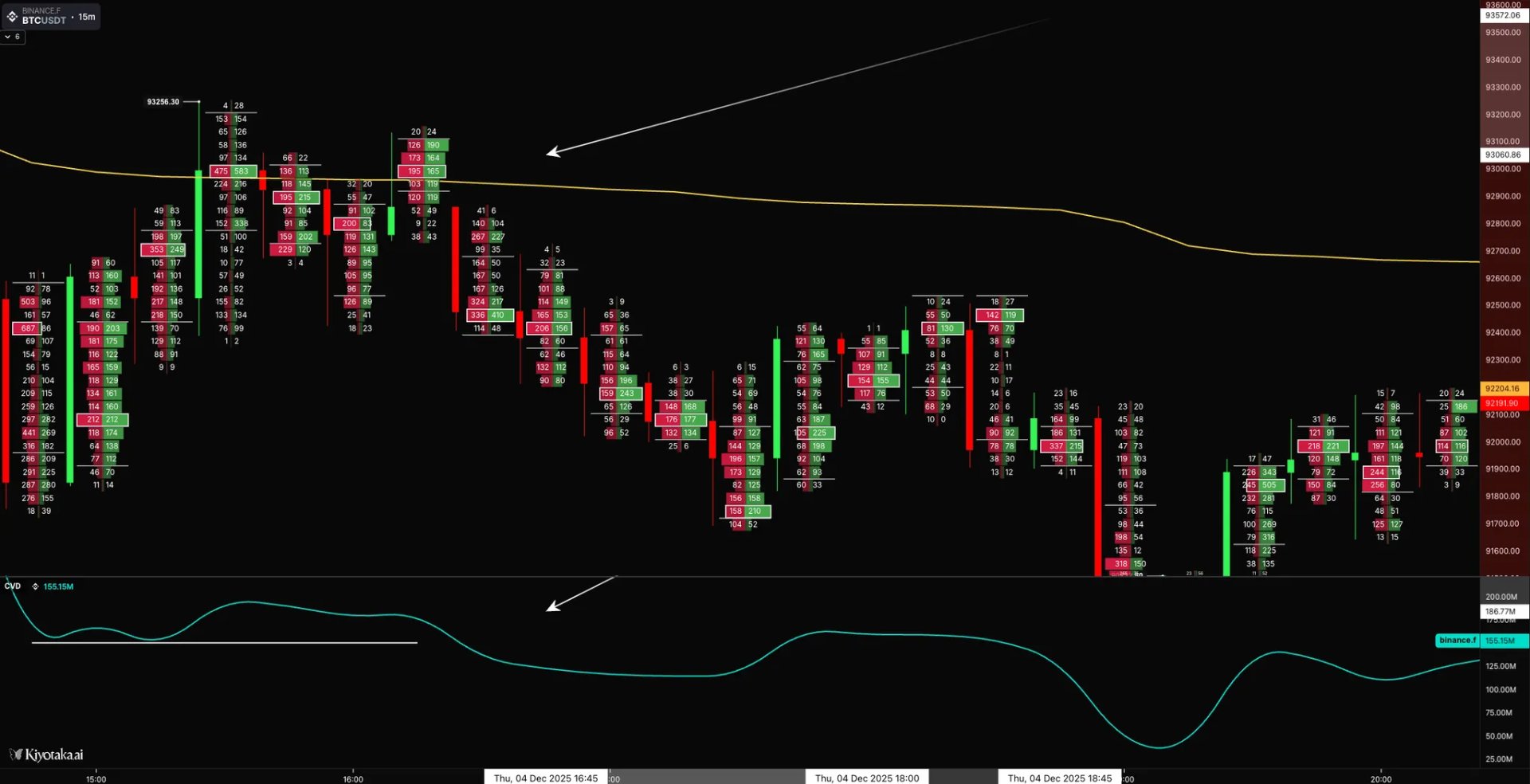
These break down volume per candle into bid/ask imbalances. Spot "stacked imbalances" near VWAP for entry signals. For example, in crypto, anchor VWAP to UTC and watch for aggressive buying footprints at that level during a dip—pair it with a session open anchor for multi-timeframe confirmation.
- In the same example as above, we’ve now dived deeper into order flow by adding the volume footprints chart. At the same moment in time, we can see a large number of buyer aggression entering the market as price attempts to extend above the VWAP, but price is reluctant to respect that aggression. Contrast this with the relatively low levels of seller aggression at the lows of candles which cross the VWAP, and price is more willing to extend below the VWAP. In conclusion, it takes buyers significantly more effort to push the market higher and eventually, they concede to sellers resulting in an extension of the downtrend.
Of course these examples are picked with the convenience of hindsight, which affords us the benefit of identifying recurring clues. Based on trading style and personality, it is up to the trader to determine what confluence of information results in an edge.
5.0 Conclusion
VWAP is a simple tool, but when used properly it gives you a clear sense of where meaningful trading activity has occurred and how price is moving relative to value. It does not predict the future or guarantee reactions, but it offers a stable reference point in a noisy market. Pair it with solid execution tools and a defined system, and it becomes a reliable part of a broader process.
Related learning
From the BackQuant learn hub
Gamma Exposure (GEX) Explained
Dealer positioning, the zero-gamma flip, and why some weeks pin while others run.
Read guideMax Pain Explained
The strike that hurts buyers most, why dealers help price get there, and where the theory breaks.
Read guideImplied Volatility, Skew, and Term Structure
IV, skew, term structure, and the volatility surface in one guide.
Read guideBTC Options Expiry (OpEx)
Friday 08:00 UTC mechanics on Deribit and the playbook traders use around expiry.
Read guide